Strategy Games
Browse all Strategy board games in the Meeple Pulse database.
Styles
AbstractAbstract StrategyAdventureAnimalsCard GameChildren's GameCivilizationCo-operativeComic Book / StripCompetitiveDiceEconomicEducationalEuroExpansion for Base-gameFamilyFan ExpansionFantasyFightingHistoricalHorrorIndustry / ManufacturingMedievalMedium HeavyMiniaturesPartyParty GamePrint & PlayPuzzle-LikeRacingReal-timeSpace ExplorationSportsStrategyTerritory BuildingThematicTransportationWargame
Themes
AbstractAdventureAncientAnimalsArtBusinessCard GameCo-operativeComic BookCooperativeCrimeEconomicEnvironmentalismExplorationFantasyFightingHistoricalHorrorHumorIntrigueLiteraryMagicMarvelMedievalModernMuseumMysteryMythologyNatureNauticalParty GamePoliticalPress Your LuckRacingSatireSci-FiSocial CommentarySocial InteractionSpaceSuperheroesThematicTravelWarWesternWord-Guessing
Mechanics
3D PlacementActingAction / DexterityAction DraftingAction Point AllowanceAction Point Allowance SystemAction Point SystemAction PointsAction ProgrammingAction QueueAction RetrievalAction SelectionAction/EventAlliancesAlternate ActivationApp-AssistedApp-DrivenArea ControlArea InfluenceArea MajorityArea Majority / InfluenceArea MovementArgumentationAsymmetricAsymmetric FactionsAsymmetric GameAsymmetric PowersAsymmetrical PowersAuction & BiddingAuction/BiddingAuctioningBag BuildingBettingBetting and BluffingBetting and WageringBetting and WagersBiddingBingoBlind BiddingBluffingCampaign / Battle Card DrivenCampaign / LegacyCampaign / Legacy GameCampaign / Mission-basedCampaign / ScenariosCampaign GameCampaign PlayCard DraftingCard DrawingCard DrivenCard Driven ActionCard Driven CombatCard Driven Dice AllocationCard Driven MovementCard ManagementCard PlayCard Play / Hand ManagementCard Play Conflict ResolutionCard SheddingCard-Driven MovementCharacter CreationCharacter ProgressionChit-Pull SystemCo-op PlayCo-operative GameCo-operative PlayCode-breakingCombat ResolutionCombo ChainCommand CardsCommodity SpeculationCommunication LimitsContract FulfillmentContractsCooperative GameCooperative GameplayCooperative PlayCooperative Trick-takingDebateDeck BuildingDeck ConstructionDeck, Bag, and Pool BuildingDeck-BuildingDeductionDexterityDice DraftingDice PlacementDice RollingDiplomatic InfluenceDraftingDynamic Battle SystemEnclosureEnd Game BonusesEngine BuildingEngine-BuildingEscape RoomEvent DrivenExplorationFarmingFlip and WriteFollowFollow ActionGrid CoverageGrid MovementHand ManagementHex-and-CounterHexagon GridHidden MovementHidden RolesI Cut You ChooseIncomeInfluence / Area MajorityLadder ClimbingLegacyLegacy ElementsLegacy GameLegacy SystemLimited CommunicationLine DrawingLine of SightMancalaMap AdditionMap MovementMarketMarket DraftingMarket ManipulationMarket MechanicMarket SpeculationMatchingMeasurement MovementMemoryMission ObjectivesModular BoardModular Board ConstructionMove Through DeckMovement PointsMovement TemplatesMulti-Use CardsMulti-use CardsMultiple ScenariosMust FollowNarrative ChoiceNarrative Choice / ParagraphNegotiationNegotiation MechanicsNetwork & Route BuildingNetwork BuildingNetwork and Route BuildingOne vs ManyOne vs. ManyOpen DraftingOwnershipPaper-and-PencilPartnershipsPattern BuildingPattern RecognitionPick-up and DeliverPlayer EliminationPlayer InteractionPlayer JudgePoint SaladPoint to Point MovementPolyominoesPush Your LuckPush-Your-LuckPuzzlePuzzle-LikePuzzle-SolvingRaceReal-TimeRecipe FulfillmentResource ManagementRole PlayingRole SelectionRoll / Spin and MoveRondelRoute BuildingRoute-BuildingRoute/Network BuildingSanity SystemScenario / Campaign PlayScenario / Mission / Campaign GameScenario / Mission FunctionSecret Unit DeploymentSemi-Cooperative GameSet CollectionSheddingSimulationSimultaneous ActionSimultaneous Action SelectionSimultaneous Hidden AllocationSocial DeductionSocial InteractionSolo / Solitaire GameSpace ExplorationStat Check / Skill CheckStat Check ResolutionStock HoldingStorytellingStrategic PlanningTableau BuildingTactical Decision-MakingTake ThatTargeted CluesTeam PlayTeam-Based GameTeam-Based GuessingTeamworkTech TreesTech Trees / Tech TracksTechnology & Armament TracksTechnology TreeTension & Aggression TracksTile DraftingTile LayingTile PlacementTime TrackTime TravelTower DefenseTrack MovementTradingTrick-takingTug of WarTurn Order: PassTurn Order: Stat-BasedUnit PlacementVariable Phase OrderVariable Player PowersVariable Set-upVariable SetupVictory Point TracksVotingWord AssociationWord GameWord GuessingWord-GuessingWord-guessingWordplayWorker Placement
RANK #288
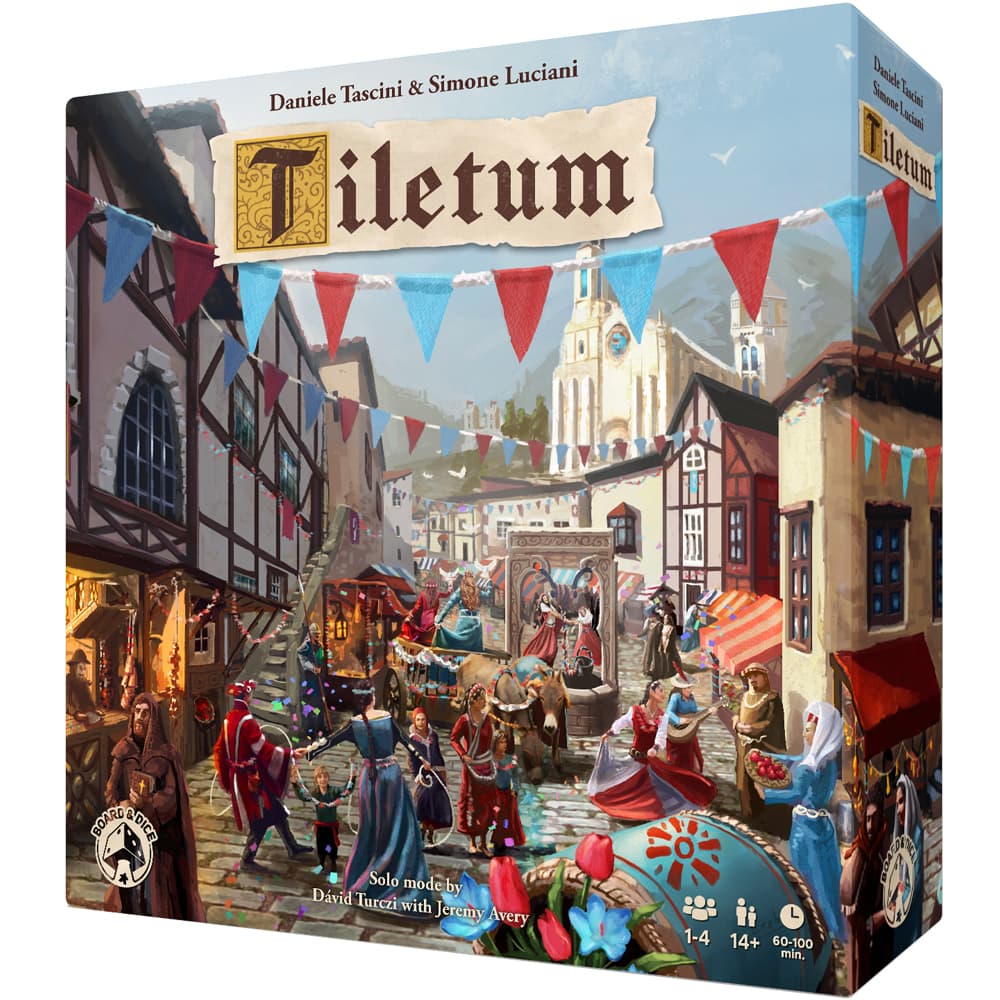
Tiletum
2022Tiletum is a sophisticated strategy board game that transports players to the bustling commerce centers of Renaissance Europe. As wealthy merchants, players strive to amass the greatest amount of prestige over the course of four intense rounds. The ultimate goal is to balance the logistics of international trade with the grandeur of architectural patronage. By traveling to different cities, players participate in legendary fairs, fulfill demanding trade contracts, and assist in the construction of iconic cathedrals. As a prominent entry in the celebrated 'T-series' from Board&Dice, the game rewards those who can master its intricate web of systems and outmaneuver their rivals in a race for historical influence.
The gameplay is driven by a central action wheel featuring an innovative 'inverse' dice mechanic that serves as the heart of the strategic engine. When drafting a die, the face value dictates the quantity of resources gained—such as gold, food, or stone—while the opposite side of the die determines the number of action points available to spend. This creates a fascinating tactical dilemma: do you take a '6' to fill your warehouses while sacrificing your ability to move, or take a '1' to perform five powerful actions with almost no materials? These actions allow you to move your architect and merchant across the continent, recruit specialists into your player board's rooms, and climb the King's track to avoid penalties and secure priority in future turns.
What truly sets Tiletum apart and explains its high acclaim is the sheer density of satisfying 'combos' players can trigger. A single move can lead to a chain reaction where completing a contract provides a bonus tile, which in turn allows for a free character placement, triggering a resource gain that helps build a trading house. This interconnectedness makes every decision feel impactful and rewarding. Furthermore, the variable setup of fairs and scoring tiles ensures high replayability, forcing players to adapt their route-building and resource-gathering strategies every session. It is a masterful blend of spatial positioning and resource management that offers a deep, heavy strategy experience while remaining surprisingly intuitive and smooth to play.
1-4 100m⚖️ 3.8
BoxNo Cover Art
RANK #289
Flamme Rouge
2016Flamme Rouge is a fast-paced, tactical bicycle racing game that transports players to the heart of a high-stakes 'one-day' classic race. Each player takes on the role of a team director managing two cyclists: the Rouleur, known for steady endurance, and the Sprinteur, capable of explosive bursts of speed. The objective is deceptively straightforward—cross the finish line first—but achieving this requires mastering the delicate balance of stamina, positioning, and timing. Set against the backdrop of the golden age of cycling, the game uses a modular track system to create unique courses every time you play, ranging from flat sprints to grueling mountain climbs that test even the most seasoned riders.
The gameplay loop revolves around a clever card-driven movement system that emphasizes hand management and deck depletion. Every round, players simultaneously draw cards for both their riders, choosing one to play and burying the others. The catch is that once a movement card is played, it is permanently removed from the game. This forces players to make difficult decisions: do you burn a high-value card now to break away from the pack, or save it for the final sprint? Positioning is critical, as the game rewards those who ride in groups through a 'slipstreaming' mechanic. If a rider ends exactly one space behind another, they are pulled forward for free, conserving their energy. Conversely, leading the pack or riding solo into the wind results in 'Exhaustion' cards being added to your deck, which act as dead weight and dilute your future drawing options.
What makes Flamme Rouge a modern classic is its ability to deliver a deep, thematic experience through incredibly accessible rules. It is easy enough for families to enjoy together but offers the tactical depth required to keep veteran strategy gamers engaged. The tension of the 'reveal' phase, where all players show their cards at once, captures the unpredictable nature of a real peloton. With its elegant design and high replayability thanks to the diverse track tiles, it offers a satisfying blend of luck and strategy. Whether you are carefully drafting to stay fresh or making a desperate dash for the flamme rouge—the red flag marking the final kilometer—every race is a cinematic experience.
2-4 45m⚖️ 1.7

RANK #290
Wondrous Creatures invites players to a hidden, mystical island teeming with extraordinary fauna. As creature enthusiasts, players embark on an expedition to scout the wilderness and establish the most prestigious wildlife reserve. The core objective is to collect species, manage rare resources, and satisfy specific achievement criteria before your rivals. By balancing the expansion of your reserve with the discovery of new life forms, you aim to build a lasting legacy as the island's premier naturalist. This title blends the charm of biological discovery with the rigors of tactical management, offering a rich and competitive tableau-building experience.
The heart of the gameplay lies in its innovative 'double-hex' worker placement system. Instead of occupying a single spot, your crew members cover two adjacent spaces on a hexagonal grid, allowing for varied resource combinations such as coral, fruit, and mushrooms. Players spend these resources to play from a massive deck of 126 unique creature cards, each offering distinct powers—instant effects, ongoing passive abilities, or powerful 'recharge' actions. The flow is punctuated by the Recharge phase, where players pull back their workers to trigger their engine and advance the global time track. This tempo-based movement toward trophies and public achievements creates a race-like tension, as early movers claim the highest-valued rewards and shape the available landscape for others.
What truly sets Wondrous Creatures apart is its high production value and deep strategic synergy. Fans of mid-to-heavy tableau builders will appreciate the intricate engine-building and the satisfaction of chaining card abilities. The inclusion of magnetic meeples—where 'Captains' mount 'Crew Members'—and the sheer variety of the 126 unique cards ensure that no two reserves feel identical. Its whimsical art style, reminiscent of a fantasy field journal, complements the mechanical depth, making it a compelling choice for strategy gamers. Whether navigating the solo mode or competing in a full four-player session, the game offers a tactile, rewarding journey through a world of imagination and discovery.
1-4 80m⚖️ 3.0
RANK #291
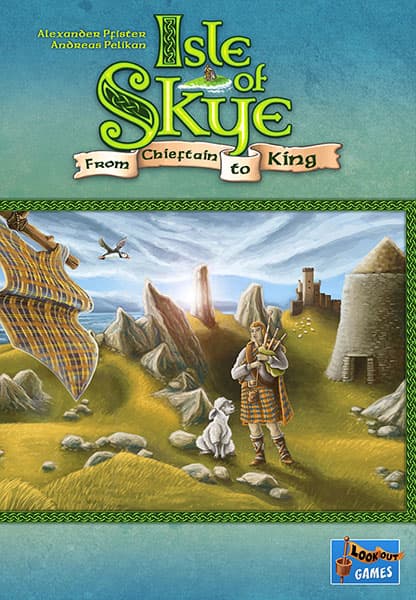
Isle of Skye: From Chieftain to King is a celebrated tile-placement and economic strategy game where players step into the shoes of ambitious clan leaders. Set against the rugged and beautiful backdrop of the Scottish Highlands, the ultimate objective is to expand your territory and accumulate the most victory points to become the rightful King of the Isle. Unlike many traditional tile-laying games, this title introduces a dynamic player-driven economy that ensures no two sessions feel the same. By strategically managing gold and territory, players must navigate a competitive landscape where every decision impacts both their own kingdom and the wealth of their opponents.
The heart of the game lies in its unique auction and pricing system. Each round, players draw three landscape tiles and secretly decide their fate behind a screen. One tile must be discarded using an 'Axe' token, while the remaining two are assigned a gold price from the player's personal reserve. This creates a fascinating risk-reward tension: pricing a tile too low makes it an easy target for rivals to purchase, while pricing it too high forces you to pay that exact amount to the bank if no one else buys it. Once prices are revealed, players take turns purchasing tiles from one another, with the remaining tiles being added to their own expanding kingdoms. Connectivity is crucial, as mountain, grass, and water edges must match perfectly. Whiskey barrels connected to the central castle via roads generate essential income, fueling future bids.
One of the most praised aspects of Isle of Skye is its variable scoring system. From a pool of sixteen different scoring tiles, only four are used in any given game, and their activation rotates through different rounds. This means players must constantly pivot their strategies—one game might reward large bodies of water, while the next focuses on the number of sheep or ships in your territory. The blend of a spatial puzzle with the cutthroat economic interaction of a price-setting auction makes it a standout 'connoisseur' level game that remains accessible to families. It offers deep strategic layers without overstaying its welcome, earning its place as a modern classic in the board gaming world.
2-5 45m⚖️ 2.3
RANK #293
Glory to Rome
2005Set in the aftermath of the Great Fire of Rome in 64 A.D., Glory to Rome is a masterpiece of card-driven design that tasks players with the monumental reconstruction of the empire's capital. As influential Roman patricians, players must compete to build structures, manage resources, and accumulate prestige points to emerge as the most powerful figure in the city. The game is celebrated for its dense, interconnected economy where every decision ripples through the state of the board. The ultimate objective is to earn the most Influence, which can be secured through building completion, stocking a private Vault with valuable materials, and strategic exploitation of special card abilities that can provide massive end-game scoring bonuses.
The engine of the game is its revolutionary multi-use card system. Each card in a player's hand can serve multiple functions: it can be played as a role to lead an action, used as a resource to fund construction, recruited as a client for permanent action bonuses, or placed as a building foundation. The core gameplay loop revolves around the 'Lead and Follow' mechanism. When the active player selects a role, such as the Architect to build or the Merchant to trade, opponents face a critical choice: they can follow the action by playing a matching card from their hand, or they can 'think' to replenish their hand or take a wildcard Jack. This ensures that every player remains engaged on every turn. Additionally, played cards flow into a central 'Pool,' creating a shared resource market that players must cleverly manipulate.
Glory to Rome is widely considered a 'grail game' within the hobby, largely due to its incredible depth and the high-octane synergy of its card effects. Fans admire how a single well-placed building can create powerful combos that fundamentally shift the game's momentum. The tension between using a card for its immediate action versus committing it as a long-term asset is constant and rewarding. Although it has faced distribution challenges and remains difficult to find in certain editions, its influence persists through successor games. It remains a definitive example of how complex strategy can be distilled into a single deck of cards, offering a medium-weight experience that rewards repeat plays and deep tactical familiarity.
2-5 60m⚖️ 2.9
RANK #294
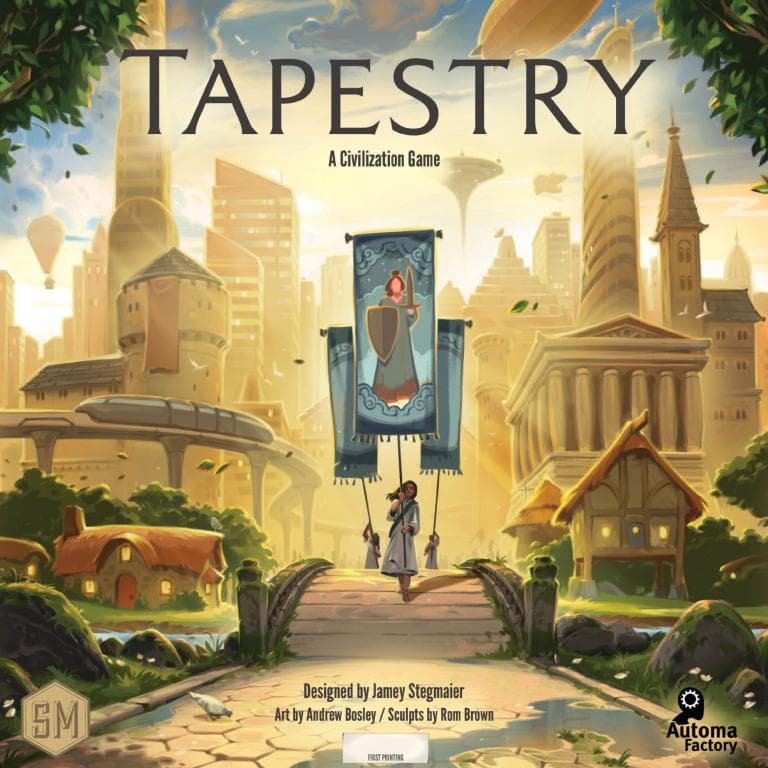
Tapestry
2019Tapestry is a civilization-building board game that breaks away from traditional historical simulations by offering a colorful, anachronistic approach to human development. Designed by Jamey Stegmaier, the game challenges players to guide a unique culture from the earliest days of discovery into the technological wonders of the near future. The primary goal is to accumulate the most victory points by advancing on four core tracks: Science, Technology, Exploration, and Military. Unlike typical '4X' games that focus heavily on combat, Tapestry emphasizes a strategic optimization puzzle where players craft their own narrative through cards and landmarks within their growing capital city.
The heart of the experience lies in a streamlined decision-making process. On every turn, a player chooses between an Advancement turn or an Income turn. Advancement involves spending resources to climb one of the four tracks, each providing immediate rewards, permanent upgrades, and powerful landmark miniatures. When resources run dry, players take an Income turn to transition into a new era. This phase allows them to collect income based on their current progress, play a Tapestry card that defines their civilization's special abilities for that era, and upgrade technology. This asymmetric structure is further enhanced by sixteen distinct civilization mats, each granting game-changing powers that require players to pivot their strategies constantly.
What truly sets Tapestry apart is its high production value and the 'simple rules, deep strategy' philosophy. The game features 18 prepainted landmark miniatures that players place on their Capital City grids to complete 3x3 districts, adding a tactile tile-laying element. Because players take exactly five income turns throughout the session, the pacing varies significantly between participants. One player might conclude their journey early while others are still in their fourth era, creating a unique tension in resource efficiency. It is a medium-weight engine-building experience that rewards long-term planning while remaining accessible to many due to its concise rulebook, offering high replayability through variable setups and asymmetric components.
1-5 105m⚖️ 2.9
RANK #295
Vindication
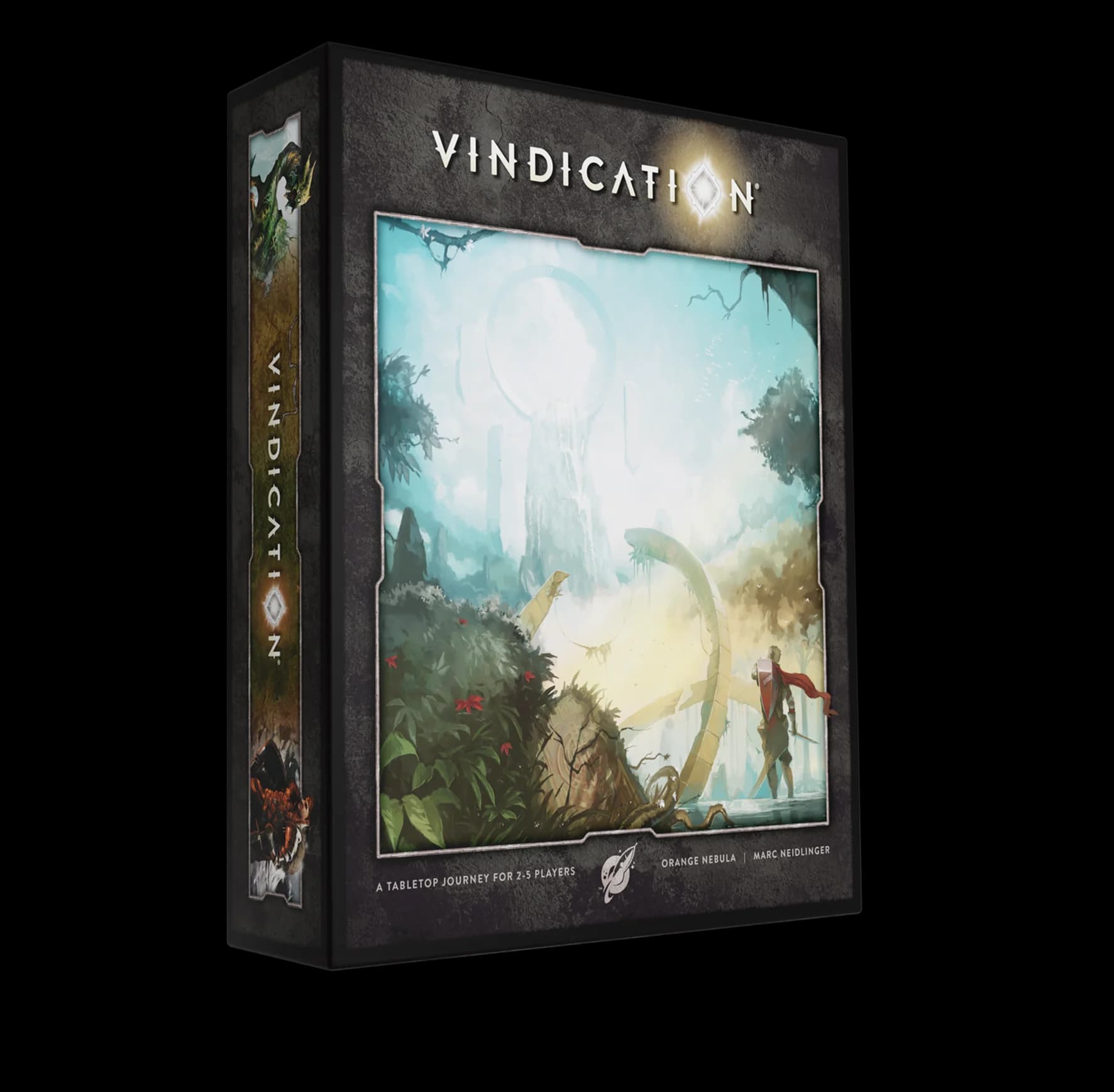
2018Vindication is a highly modular strategy board game where players take on the role of a disgraced individual, cast overboard by their peers to die in the surf of a mysterious, magical island. From this lowly start as a 'wretched' character, you must navigate a path toward redemption and honor. The core objective is to accumulate the most Honor points by the time one of the variable endgame triggers is met. Set in a rich fantasy world, the game emphasizes player agency and high-production components, challenging participants to shed their dark past and become truly vindicated through heroic deeds and strategic growth.
The gameplay loop is centered on an elegant 'Action Trio' system. On every turn, players perform three distinct actions in any order: moving across the hexagonal modular board, activating companions or character abilities, and either visiting a specific tile or resting to recover power. The resource management is particularly unique, utilizing a three-tier system of power cubes. Players move cubes from 'Potential' to 'Influence' and finally to 'Conviction.' This engine powers 'Attribute Alchemy,' where basic resources like Inspiration, Knowledge, or Strength are combined into advanced traits like Wisdom or Courage. These elite attributes are necessary to recruit powerful allies, secure relics, and defeat the monstrous threats lurking on the island.
One of the most praised aspects of Vindication is its open-world feel and high degree of replayability. Because the endgame conditions are variable and based on player progress or deck depletion, no two sessions feel the same. The game avoids the rigid structure of fixed rounds, allowing for a dynamic tempo that responds to the players' strategies. Fans of the game are often drawn to its stunning aesthetics, including high-quality card art and tactile game trays, alongside the deeply satisfying feeling of building a powerful engine from nothing. Whether you are exploring new territories, mastering the alchemy of attributes, or taking permanent control of locations, the path to glory is as varied as the island itself.
1-5 90m⚖️ 3.1
RANK #296
Roll Player
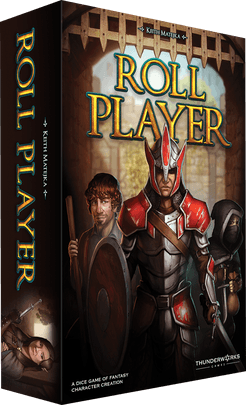
2016Roll Player is a creative board game that turns the classic tabletop RPG character creation process into a full competitive experience. Instead of embarking on a dungeon crawl, players are focused entirely on the preparation stage—building the most powerful and well-rounded fantasy hero possible. Set in the world of Ulos, each player takes on the role of a character with a specific race, class, and backstory. The primary objective is to earn the most Reputation Stars by the end of the game, which are awarded for meeting attribute requirements, fulfilling backstory goals, aligning your character's morality, and gathering powerful gear from the local market.
The gameplay revolves around a central dice-drafting mechanic spanning several rounds. Each round, dice are rolled and placed on initiative cards. Players take turns selecting a die to place on their character sheet in specific attribute rows like Strength, Intelligence, or Charisma. Each placement triggers a unique attribute action, allowing players to manipulate their dice by flipping them to opposite sides, re-rolling them, or swapping positions. This creates a deep, puzzle-like environment where players must carefully manage their resources and dice values. After the drafting phase, players visit the market to spend gold on skills, traits, and armor sets, all of which provide additional ways to score points or gain tactical advantages during future rounds.
What makes Roll Player so beloved is its ingenious 'gamification' of a meta-concept. It captures the nostalgic joy of rolling stats for a Dungeons & Dragons character while providing a rigorous strategic framework. The tension between picking the 'perfect' die for your stats versus picking an earlier initiative card to get the best equipment in the market makes for a compelling decision space. It is a highly satisfying optimization puzzle that feels thematic and rewarding, especially as you see your hero come together from a blank slate to a fully equipped champion. With a moderate complexity level, it is accessible enough for casual gamers while offering enough depth for strategy enthusiasts.
1-4 75m⚖️ 2.4
RANK #297
Skull King
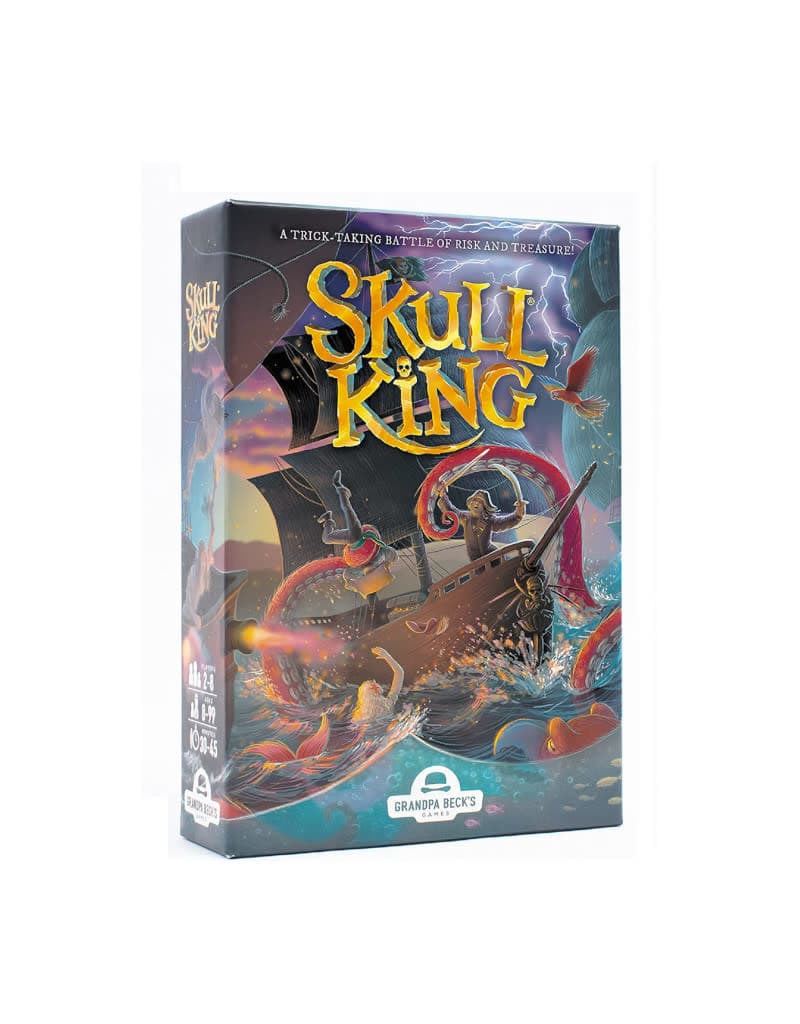
2013Skull King is a high-stakes, pirate-themed trick-taking game that invites players to set sail on the high seas in search of loot and glory. Originally released in 2013, it has established itself as a modern classic in the predictive bidding genre, often compared to legendary games like 'Wizard' or 'Oh Hell!'. The ultimate goal is to accumulate the most points over ten rounds by accurately predicting exactly how many tricks you will capture in each hand. Unlike traditional card games where the strongest hand always wins, Skull King rewards precision and psychological maneuvering, forcing players to balance aggression with calculated retreats.
The game progresses through ten rounds, with the hand size increasing by one card each round. After examining their cards, all players simultaneously declare their bids using the iconic 'Yo-Ho-Ho!' chant, revealing their intended trick count with their fists. The core of the game lies in its intricate power hierarchy. While players must follow the lead suit of Parrots, Maps, or Chests, they can pivot to the black Jolly Roger trump suit or deploy powerful special cards. Pirates can dominate numbered cards, but they are vulnerable to the dreaded Skull King. However, even the King can be lured to his doom by the alluring Mermaid. This rock-paper-scissors dynamic ensures that no lead is ever truly safe, and the tide of battle can turn with a single card.
What makes Skull King truly beloved by gaming groups is its blend of high-energy social interaction and deep strategic depth. The scoring system is brutal yet rewarding; players earn 20 points per trick for a correct bid but lose 10 points for every trick they are off. The legendary 'bid zero' strategy offers a high-risk, high-reward path to victory, potentially granting massive points or leading to a devastating shipwreck. The game's charm lies in these moments of triumph and betrayal, where a well-timed Escape card or a surprise Pirate can ruin an opponent's perfect round. It remains a staple for families and hobbyists alike due to its accessibility and the endless variety provided by its special character cards.
2-6 45m⚖️ 1.8
BoxNo Cover Art
RANK #298
Anno 1800: The Board Game, a captivating Eurogame released in 2020, beautifully translates the intricate city-building experience of its video game namesake into a tabletop format. Designed by the esteemed Martin Wallace, this strategy title immerses players in the heart of the Industrial Revolution, tasking them with developing a thriving island economy. The overarching goal is a strategic "race" to satisfy the increasingly complex needs of your population, represented by a hand of Population Cards that players aim to empty. It’s a game of careful planning, resource optimization, and dynamic player interaction, where every decision shapes your burgeoning industrial empire.
The core gameplay loop revolves around selecting one of nine distinct actions on your turn, a mechanism that provides a flexible yet constrained strategic environment. Instead of traditional resource accumulation, players "produce" goods by exhausting population cubes from various building tiles, instantly generating the necessary resources for current actions. These resources are then used to either play the crucial Population Cards from your hand, unlocking points and bonuses, or to construct new, higher-tier industries that produce more advanced goods. Population management is key: increasing your workforce grants more actions per round, but also forces you to draw more Population Cards, extending the challenge of fulfilling your citizens' demands and escalating the strategic race.
What truly sets Anno 1800 apart is its innovative and dynamic trade system. If a player lacks a specific resource, they can trade with any opponent who possesses the corresponding industry. This trade is non-refusable; the active player spends a trade token, and the recipient gains one gold, without expending their own resources or actions. This ingenious system strongly encourages players to specialize their industries rather than attempting to produce every good, fostering a high degree of player interaction and negotiation throughout the game. Fans praise its ability to replicate the video game's recursive production chains and satisfying engine-building without becoming overly bogged down in calculations, offering a rewarding, "puzzle-like" experience for strategists and optimization enthusiasts.
2-4 120m⚖️ 3.8
BoxNo Cover Art
RANK #299
Hallertau
2020Set in the mid-19th century within the lush Hallertau region of Bavaria, Germany, Hallertau invites players to step into the shoes of village mayors dedicated to agricultural expansion and civic improvement. The primary objective is to cultivate the local economy by efficiently managing crops and livestock to accumulate wealth and prestige. This historical setting isn't just window dressing; it reflects the region's status as the world's premier hop-producing area. Players strive to outmaneuver their rivals by modernizing their village, represented by the advancement of a massive Community Center tile across their personal boards. The player who most effectively balances the demands of the land with the industrial needs of their town will emerge as the most successful leader of this burgeoning rural hub.
The gameplay loop of Hallertau is a sophisticated blend of classic Uwe Rosenberg concepts and bold new innovations. It utilizes a progressive worker placement system where action spaces do not become blocked, but instead grow more expensive as more players utilize them. Each of the six rounds requires players to allocate their limited workforce to gather seeds, sow fields, and tend to sheep. A standout mechanic is the two-field crop rotation system, which simulates soil exhaustion and recovery. Planting a crop lowers a field’s future yield, while leaving it fallow allows it to recover and produce more in subsequent seasons. Simultaneously, players must solve the 'Community Center Puzzle,' spending resources to push five different craft buildings to the right. This movement allows the Community Center to slide forward, which simultaneously increases the player's available workers for future rounds and generates significant victory points.
What truly distinguishes Hallertau and drives its massive popularity is its incredible flexibility and replayability. With over 300 cards divided into several distinct decks—Gateway, Farmyard, Bonus, and Point cards—no two games ever unfold the same way. The ability to play these cards at almost any time during a turn allows for tactical pivots and high-scoring combos that feel immensely rewarding. Unlike the tighter, more restrictive resource management found in Rosenberg's earlier titles like Agricola, Hallertau offers a more forgiving, sandbox-style experience. It rewards clever planning and adaptation rather than penalizing minor inefficiencies. The combination of the sliding board puzzle, the strategic depth of field rotation, and the constant flow of diverse card effects creates a medium-heavy experience that is both intellectually stimulating and deeply satisfying for solo and multiplayer enthusiasts alike.
1-4 95m⚖️ 3.3

RANK #300
Set in the vibrant heart of the Italian Renaissance, The Princes of Florence invites players to step into the shoes of ambitious aristocrats during the 15th century. Your primary objective is to transform your local estate into a beacon of cultural excellence, attracting the finest artists, scholars, and scientists of the age to create masterpieces. Through careful planning and strict economic management, players compete for prestige by facilitating the creation of magnificent works. The game is celebrated for its tight balance between building a sustainable financial engine and pursuing pure victory points, perfectly mirroring the real-world tension of historical patronage where art requires both high-minded passion and cold, hard florins.
The gameplay unfolds over seven structured rounds, each consisting of an intense auction followed by a strategic action phase. During the auction, players bid on essential resources like landscapes, jesters, and builders, though there is a critical catch: you can only win one item per round, and the availability is strictly limited. Once the bidding settles, players use two actions to develop their estates. You might choose to place polyomino building tiles on your grid, grant social freedoms, or recruit new talent via profession cards. The core challenge involves fulfilling 'Work' cards by meeting specific environmental requirements—such as having a certain building or freedom—which generates a numerical value. You must then decide whether to convert this value into money for future investments or prestige points to climb the leaderboard.
What distinguishes this title from other classic Eurogames is its remarkable mathematical elegance and high level of player interaction through the bidding process. It offers a puzzle-like experience as you attempt to fit Tetris-style buildings into a cramped estate board while timing your auctions perfectly to outmaneuver rivals. The game demands foresight, as the requirements to satisfy your artists increase in difficulty every round. Because every florin and every square inch of your estate matters, the game provides a deeply satisfying sense of accomplishment when a complex strategy finally pays off. It remains a foundational title for enthusiasts who enjoy economic efficiency and tight competition, offering a masterclass in how simple rules can create profound strategic depth.
1-5 90m⚖️ 3.2