Ancient Games
Browse all Ancient board games in the Meeple Pulse database.
Styles
Themes
AbstractAdventureAncientAnimalsArtBusinessCard GameCo-operativeComic BookCooperativeCrimeEconomicEnvironmentalismExplorationFantasyHistoricalHorrorHumorIntrigueLiteraryMagicMarvelMedievalModernMuseumMysteryMythologyNatureNauticalPoliticalPress Your LuckSatireSci-FiSocial CommentarySocial InteractionSpaceSuperheroesThematicTravelWarWesternWord-Guessing
Mechanics
3D PlacementActingAction / DexterityAction DraftingAction Point AllowanceAction Point Allowance SystemAction Point SystemAction PointsAction ProgrammingAction QueueAction RetrievalAction SelectionAction/EventAlliancesAlternate ActivationApp-AssistedApp-DrivenArea ControlArea InfluenceArea MajorityArea Majority / InfluenceArea MovementArgumentationAsymmetricAsymmetric FactionsAsymmetric GameAsymmetric PowersAsymmetrical PowersAuction & BiddingAuction/BiddingAuctioningBag BuildingBettingBetting and BluffingBetting and WageringBetting and WagersBiddingBingoBlind BiddingBluffingCampaign / Battle Card DrivenCampaign / LegacyCampaign / Legacy GameCampaign / Mission-basedCampaign / ScenariosCampaign GameCampaign PlayCard DraftingCard DrawingCard DrivenCard Driven ActionCard Driven CombatCard Driven Dice AllocationCard Driven MovementCard ManagementCard PlayCard Play / Hand ManagementCard Play Conflict ResolutionCard SheddingCard-Driven MovementCharacter CreationCharacter ProgressionChit-Pull SystemCo-op PlayCo-operative GameCo-operative PlayCode-breakingCombat ResolutionCombo ChainCommand CardsCommodity SpeculationCommunication LimitsContract FulfillmentContractsCooperative GameCooperative GameplayCooperative PlayCooperative Trick-takingDebateDeck BuildingDeck ConstructionDeck, Bag, and Pool BuildingDeck-BuildingDeductionDexterityDice DraftingDice PlacementDice RollingDiplomatic InfluenceDraftingDynamic Battle SystemEnclosureEnd Game BonusesEngine BuildingEngine-BuildingEscape RoomEvent DrivenExplorationFarmingFlip and WriteFollowFollow ActionGrid CoverageGrid MovementHand ManagementHex-and-CounterHexagon GridHidden MovementHidden RolesI Cut You ChooseIncomeInfluence / Area MajorityLadder ClimbingLegacyLegacy ElementsLegacy GameLegacy SystemLimited CommunicationLine DrawingLine of SightMancalaMap MovementMarketMarket DraftingMarket ManipulationMarket MechanicMarket SpeculationMatchingMeasurement MovementMemoryMission ObjectivesModular BoardModular Board ConstructionMovement TemplatesMulti-Use CardsMulti-use CardsMultiple ScenariosMust FollowNarrative ChoiceNarrative Choice / ParagraphNegotiationNegotiation MechanicsNetwork & Route BuildingNetwork BuildingNetwork and Route BuildingOne vs ManyOne vs. ManyOpen DraftingPaper-and-PencilPartnershipsPattern BuildingPattern RecognitionPick-up and DeliverPlayer EliminationPlayer InteractionPlayer JudgePoint SaladPoint to Point MovementPolyominoesPush Your LuckPush-Your-LuckPuzzlePuzzle-LikePuzzle-SolvingRaceReal-TimeRecipe FulfillmentResource ManagementRole PlayingRole SelectionRoll / Spin and MoveRondelRoute BuildingRoute-BuildingRoute/Network BuildingSanity SystemScenario / Campaign PlayScenario / Mission / Campaign GameScenario / Mission FunctionSecret Unit DeploymentSemi-Cooperative GameSet CollectionSheddingSimulationSimultaneous ActionSimultaneous Action SelectionSimultaneous Hidden AllocationSocial DeductionSocial InteractionSolo / Solitaire GameSpace ExplorationStat Check / Skill CheckStock HoldingStorytellingStrategic PlanningTableau BuildingTactical Decision-MakingTake ThatTargeted CluesTeam PlayTeam-Based GameTeam-Based GuessingTeamworkTech TreesTech Trees / Tech TracksTechnology & Armament TracksTechnology TreeTension & Aggression TracksTile DraftingTile LayingTile PlacementTime TrackTime TravelTower DefenseTrack MovementTradingTrick-takingTug of WarTurn Order: PassTurn Order: Stat-BasedUnit PlacementVariable Phase OrderVariable Player PowersVariable Set-upVariable SetupVictory Point TracksVotingWord AssociationWord GameWord GuessingWord-GuessingWord-guessingWordplayWorker Placement
BoxNo Cover Art
RANK #95
In the fabled Sultanate of Naqala, the old Sultan has died, leaving the throne vacant. The future of the city is in your hands as you compete to gain the favor of the legendary Five Tribes. In a clever twist on the worker placement genre, Five Tribes begins with the game board already populated with meeples. Your objective is not to place workers, but to skillfully maneuver the existing tribes across the grid of tiles, claiming valuable territories and invoking the power of ancient Djinns to secure your path to victory. To win, you must accumulate the most Victory Points by the end of the game, proving you have the wisdom and influence to become the next Sultan.
The game's signature mechanic is its elegant, Mancala-style movement system. On your turn, you will choose a tile, pick up all the meeples on it, and distribute them one-by-one onto adjacent tiles. Your final meeple must land on a tile containing another meeple of the same color. This triggers your main action: you collect all meeples of that color from the final tile and perform their tribe's special ability. Yellow Viziers provide points, White Elders can summon Djinns, Green Merchants gather valuable goods, Blue Builders generate gold, and Red Assassins can remove other meeples from play. If your move completely clears a tile of its occupants, you gain control of it by placing one of your camels, locking in its point value for the end of the game.
Five Tribes is beloved for its remarkable strategic depth packed into a relatively straightforward ruleset. The sheer number of possible moves on any given turn creates a rich, puzzle-like experience that rewards careful planning and foresight. A tense bidding phase kicks off each round, forcing players to spend their hard-earned currency to secure a favorable turn order, creating a constant trade-off between acting early and preserving points. The ability to recruit powerful Djinns, each offering a unique and often game-breaking rule modification, adds immense variety and replayability. With multiple scoring avenues—from controlling land to collecting merchandise sets and assembling powerful entourages—the game remains a dynamic and engaging modern classic.
2-4 60m⚖️ 2.9
RANK #252
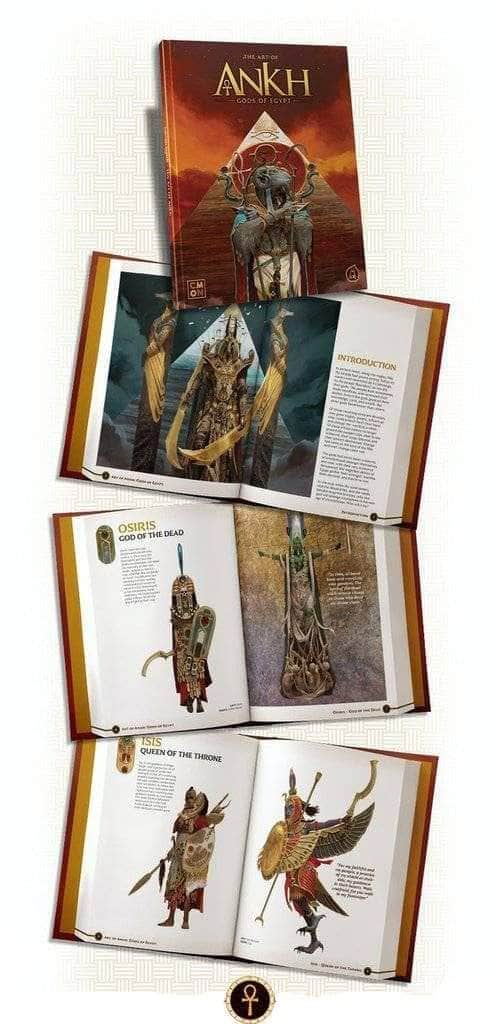
Ankh: Gods of Egypt transports players to a mythical past where the old ways are fading and the people of Egypt are beginning to favor a single, monotheistic religion. In this fiercely competitive game, 2 to 5 players take on the roles of legendary Egyptian deities like Ra, Anubis, and Isis, each struggling for dominance and survival. The ultimate goal is to become the last god standing, the sole object of worship for all of Egypt. This is achieved by accumulating Devotion, the game's victory points, which are earned through strategic control of monuments, demonstrations of power in battle, and the loyalty of your followers. As the game progresses, the stakes get higher, and gods who fall too far behind in Devotion face the ultimate threat: being forgotten by history forever.
The gameplay is driven by an elegant and highly tactical action selection system. On their turn, a player performs one or two of four possible actions—moving their figures, summoning units, gaining followers, or unlocking unique Ankh powers—and advances a corresponding marker on a shared event track. When a marker reaches the end of its path, a game-altering event is triggered for all players. These events include claiming control of powerful monuments, strategically dividing the board into new regions with camel caravans, and, most importantly, initiating Conflict. Combat is a deterministic affair, completely free of dice rolls. Players commit battle cards from their hand and sum the strength of their god and warriors in a region to determine the victor. A truly unique and dramatic feature for games with three or more players is the Merge event, where the two players with the lowest Devotion scores are forced to combine their powers, becoming a single, more powerful entity for the remainder of the game.
What makes Ankh: Gods of Egypt so compelling is its blend of pure strategy and intense player interaction. The absence of randomness in combat means every victory and defeat rests squarely on the players' shoulders, rewarding careful planning and clever card play. The shared action track creates a fascinating puzzle, as every action you take brings the game closer to an event that might benefit your opponents more than you. The game is a constant battle of wits, where you must anticipate your rivals' moves while advancing your own position. The god-merging mechanic is a brilliant twist, ensuring that no player feels completely out of the running and introducing a surprising cooperative dynamic into a cutthroat competitive game. It is a stunning conclusion to a celebrated trilogy of mythology-themed games, offering a deep, rewarding, and unforgettable strategic experience.
2-5 90m⚖️ 3.1
RANK #293
Glory to Rome
2005Set in the aftermath of the Great Fire of Rome in 64 A.D., Glory to Rome is a masterpiece of card-driven design that tasks players with the monumental reconstruction of the empire's capital. As influential Roman patricians, players must compete to build structures, manage resources, and accumulate prestige points to emerge as the most powerful figure in the city. The game is celebrated for its dense, interconnected economy where every decision ripples through the state of the board. The ultimate objective is to earn the most Influence, which can be secured through building completion, stocking a private Vault with valuable materials, and strategic exploitation of special card abilities that can provide massive end-game scoring bonuses.
The engine of the game is its revolutionary multi-use card system. Each card in a player's hand can serve multiple functions: it can be played as a role to lead an action, used as a resource to fund construction, recruited as a client for permanent action bonuses, or placed as a building foundation. The core gameplay loop revolves around the 'Lead and Follow' mechanism. When the active player selects a role, such as the Architect to build or the Merchant to trade, opponents face a critical choice: they can follow the action by playing a matching card from their hand, or they can 'think' to replenish their hand or take a wildcard Jack. This ensures that every player remains engaged on every turn. Additionally, played cards flow into a central 'Pool,' creating a shared resource market that players must cleverly manipulate.
Glory to Rome is widely considered a 'grail game' within the hobby, largely due to its incredible depth and the high-octane synergy of its card effects. Fans admire how a single well-placed building can create powerful combos that fundamentally shift the game's momentum. The tension between using a card for its immediate action versus committing it as a long-term asset is constant and rewarding. Although it has faced distribution challenges and remains difficult to find in certain editions, its influence persists through successor games. It remains a definitive example of how complex strategy can be distilled into a single deck of cards, offering a medium-weight experience that rewards repeat plays and deep tactical familiarity.
2-5 60m⚖️ 2.9
RANK #294
Tapestry
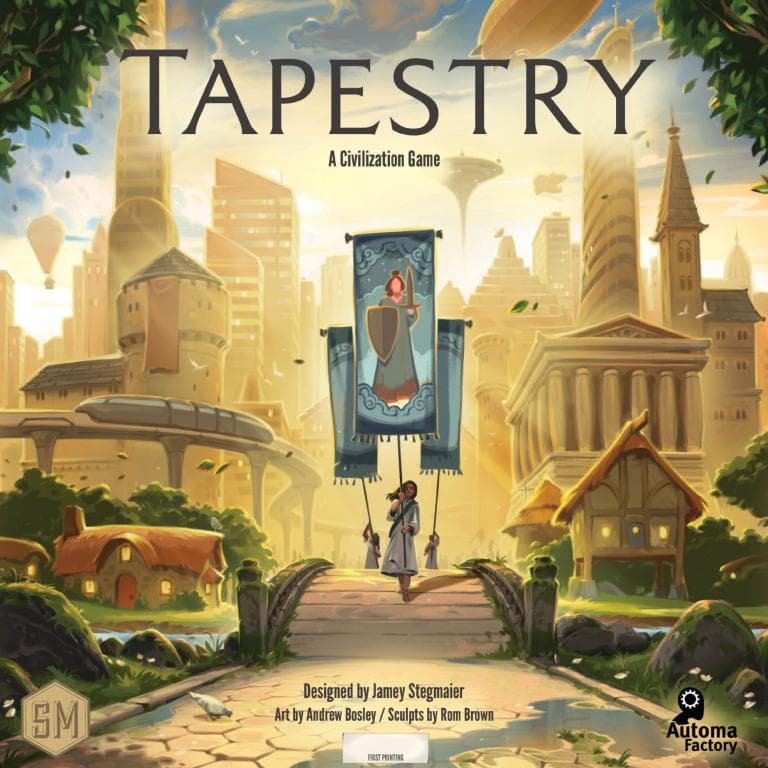
2019Tapestry is a civilization-building board game that breaks away from traditional historical simulations by offering a colorful, anachronistic approach to human development. Designed by Jamey Stegmaier, the game challenges players to guide a unique culture from the earliest days of discovery into the technological wonders of the near future. The primary goal is to accumulate the most victory points by advancing on four core tracks: Science, Technology, Exploration, and Military. Unlike typical '4X' games that focus heavily on combat, Tapestry emphasizes a strategic optimization puzzle where players craft their own narrative through cards and landmarks within their growing capital city.
The heart of the experience lies in a streamlined decision-making process. On every turn, a player chooses between an Advancement turn or an Income turn. Advancement involves spending resources to climb one of the four tracks, each providing immediate rewards, permanent upgrades, and powerful landmark miniatures. When resources run dry, players take an Income turn to transition into a new era. This phase allows them to collect income based on their current progress, play a Tapestry card that defines their civilization's special abilities for that era, and upgrade technology. This asymmetric structure is further enhanced by sixteen distinct civilization mats, each granting game-changing powers that require players to pivot their strategies constantly.
What truly sets Tapestry apart is its high production value and the 'simple rules, deep strategy' philosophy. The game features 18 prepainted landmark miniatures that players place on their Capital City grids to complete 3x3 districts, adding a tactile tile-laying element. Because players take exactly five income turns throughout the session, the pacing varies significantly between participants. One player might conclude their journey early while others are still in their fourth era, creating a unique tension in resource efficiency. It is a medium-weight engine-building experience that rewards long-term planning while remaining accessible to many due to its concise rulebook, offering high replayability through variable setups and asymmetric components.
1-5 105m⚖️ 2.9
Concordia: Salsa
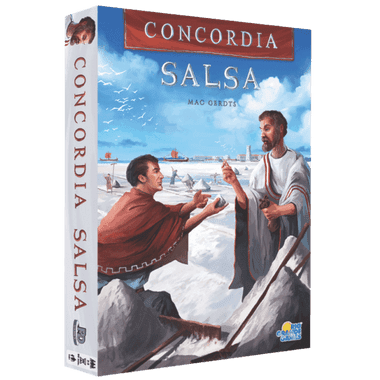
2015Concordia: Salsa (2015) is a highly anticipated expansion for the critically acclaimed strategy game Concordia, enriching the Roman Empire-era economic experience. This expansion introduces two new maps – Byzantium and Egypt – alongside two innovative modules: 'Salt' and the 'Forum'. Players continue their quest to establish the most prosperous trading empire by strategically expanding across the Mediterranean, managing their hand of personality cards, and collecting valuable resources. The ultimate goal remains to score the most victory points, primarily determined by the diverse types of colonists, goods, and provinces they've established and collected throughout the game.
Gameplay in Concordia: Salsa expands upon the elegant card-driven core of Concordia. Players use their hand of identical personality cards to perform various actions like moving colonists, producing goods, trading, or buying new cards. The 'Salt' module introduces a new, highly flexible resource that can substitute for any other good, adding a layer of strategic depth to resource management and trade. The 'Forum' module introduces a market of unique bonus tiles, granting players powerful one-time or ongoing abilities when claimed, further diversifying strategic choices and offering exciting new ways to specialize or adapt. These additions seamlessly integrate with the base game, providing more paths to victory and dynamic player interactions.
Fans adore Concordia: Salsa for its brilliant integration of new elements without sacrificing the base game's renowned elegance and strategic depth. The 'Salt' resource offers greater tactical flexibility, while the 'Forum' tiles introduce exciting variable player powers and a unique race component, enhancing replayability and creating fresh challenges in every play. It maintains Concordia's signature low-luck, high-strategy appeal, rewarding careful planning and efficient execution, making it a must-have for those seeking to deepen their mastery of this modern classic and explore new strategic horizons.
2-5 120m⚖️ 3.0
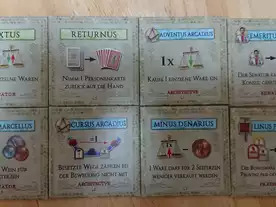
The Concordia: 8 Forum Cards mini-expansion is an essential upgrade for fans of the acclaimed strategy game Concordia, enriching the core experience with powerful, unique abilities that challenge players to adapt their economic and expansion strategies in ancient Roman times. It maintains the original goal of achieving prosperity and influence across the Roman Empire, but introduces exciting new avenues for tactical advantage and strategic planning, ensuring every game presents fresh and compelling choices.
This mini-expansion seamlessly integrates into Concordia's elegant card-driven gameplay. At the start of the game, players draft two Forum Cards, selecting one to keep. These cards provide asymmetrical player powers or special actions, such as gaining extra resources, relocating colonists more efficiently, or altering scoring conditions. They introduce a significant layer of strategic depth, forcing players to consider new synergies with their existing hand management and set collection decisions, and respond to the evolving board state with a broader array of tactical options.
Players love the Concordia: 8 Forum Cards for its ability to significantly boost replayability and introduce intriguing strategic variability without adding unnecessary rules complexity. It maintains the game's streamlined nature while offering tough new choices from the very first turn. The unique appeal lies in how these diverse Forum abilities transform familiar strategies, encouraging creative problem-solving and ensuring every game feels distinct and engaging, making it a must-have for seasoned Concordia enthusiasts looking for more depth.
2-5 90m⚖️ 3.0
BoxNo Cover Art
Gods & Mortals
2026In Gods & Mortals, you ascend to the pantheon of ancient Greece, embodying legendary deities like Zeus, Ares, or Athena. Your goal is not mere conquest, but to achieve ultimate supremacy by cleverly manipulating the mortal civilizations that worship you. Set across the Aegean, the game features four distinct mortal factions—the Trojans, Achaeans, Minoans, and Amazons—vying for territorial control. These factions are not your loyal subjects but rather instruments in your grand design. Your objective over five rounds is to prove your divine prowess by outwitting the other gods, growing your influence, and ensuring your name is the one most revered when the final reckoning arrives.
The gameplay innovatively merges area control with a stock market-like investment system. Mortals are treated as joint-stock companies in which you invest your divine essence. During each round's 'divinity phase,' you will allocate your resources to the factions you believe will prosper. However, your allegiance is fleeting. You can 'abandon' a faction at a key moment to capitalize on its success, reaping rewards to further your own agenda. Following the investment phase, the 'action phase' unfolds with quick, interactive turns. Here, you play cards to command armies, spark conflicts, erect temples, and unleash your god’s unique, powerful abilities. This creates a fascinating codependency: gods need mortal belief to fuel their power, and mortals need divine patronage to survive and expand, making every decision a delicate balance of support and exploitation.
What makes Gods & Mortals compelling is its fresh take on strategic conflict. The blend of area control with speculative investment forces players into a constant state of flux, rewarding adaptability and shrewd timing over brute force. You are not just a warrior god; you are a divine investor playing a long game of influence. The asymmetric powers of each god guarantee that no two games feel the same, offering deep strategic paths and high replayability. While the rules are designed to be accessible, the decisions are described as 'crunchy' and meaningful, creating a satisfying experience for players who enjoy emergent strategies and high levels of interaction with minimal downtime. It’s a battle of wits where the most cunning god, not the strongest, will claim victory.
2-4 75m⚖️ 2.9
BoxNo Cover Art
Altay: Dawn of Civilization is a sophisticated blend of civilization-building, deck-building, and area control, set against the backdrop of a prehistoric, mythical Eurasia. In this game, players represent one of four distinct civilizations—the Alans, the Uigurs, the Khazars, or the Bulgars—striving to expand their influence across the rugged landscapes of the Altay mountains. The primary objective is to accumulate the most victory points by controlling territories, constructing settlements, and advancing your culture's technological and social standing. It is a game of expansion and evolution, where every decision shapes the legacy of your people as you transition from a small tribe into a dominant regional power.
The gameplay loop revolves around a highly interactive deck-building system that directly dictates your actions on the physical game board. Unlike traditional deck-builders where the board is secondary, in Altay, your cards are the literal engine for movement, combat, and resource extraction. Players must carefully manage their hand to deploy settlers, harvest essential resources like wood, stone, and metal, and use those materials to build permanent structures that provide ongoing benefits. A standout mechanic is the 'development' system, where players can acquire new, more powerful cards that represent technological breakthroughs or cultural milestones, allowing for deep customization of their deck's strategic focus. This creates a satisfying progression where your capabilities grow exponentially as the game progresses.
What truly distinguishes Altay: Dawn of Civilization is its seamless integration of different genres, crafted by the renowned design duo of Paolo Mori and Simone Luciani. Fans of strategy games will appreciate how the tactical 'dudes on a map' aspect is elegantly balanced by the long-term planning required in deck optimization. The game avoids the stagnation often found in area control titles by ensuring that the board state is constantly evolving through card-driven initiatives. The unique asymmetric starting positions and civilization-specific decks provide high replayability, challenging players to master different paths to victory. With its evocative artwork and tight, interlocking systems, Altay offers a rich, immersive experience that rewards both tactical flexibility and strategic foresight, making it a modern masterpiece for those who enjoy mid-to-heavy weight eurogames.
2-4 90m⚖️ 3.2