Tile Placement Games
Browse all Tile Placement board games in the Meeple Pulse database.
Styles
Themes
AbstractAdventureAncientAnimalsArtBusinessCard GameCo-operativeComic BookCooperativeCrimeEconomicEnvironmentalismExplorationFantasyHistoricalHorrorHumorIntrigueLiteraryMagicMarvelMedievalModernMuseumMysteryMythologyNatureNauticalPoliticalPress Your LuckSatireSci-FiSocial CommentarySocial InteractionSpaceSuperheroesThematicTravelWarWesternWord-Guessing
Mechanics
3D PlacementActingAction / DexterityAction DraftingAction Point AllowanceAction Point Allowance SystemAction Point SystemAction PointsAction ProgrammingAction QueueAction RetrievalAction SelectionAction/EventAlliancesAlternate ActivationApp-AssistedApp-DrivenArea ControlArea InfluenceArea MajorityArea Majority / InfluenceArea MovementArgumentationAsymmetricAsymmetric FactionsAsymmetric GameAsymmetric PowersAsymmetrical PowersAuction & BiddingAuction/BiddingAuctioningBag BuildingBettingBetting and BluffingBetting and WageringBetting and WagersBiddingBingoBlind BiddingBluffingCampaign / Battle Card DrivenCampaign / LegacyCampaign / Legacy GameCampaign / Mission-basedCampaign / ScenariosCampaign GameCampaign PlayCard DraftingCard DrawingCard DrivenCard Driven ActionCard Driven CombatCard Driven Dice AllocationCard Driven MovementCard ManagementCard PlayCard Play / Hand ManagementCard Play Conflict ResolutionCard SheddingCard-Driven MovementCharacter CreationCharacter ProgressionChit-Pull SystemCo-op PlayCo-operative GameCo-operative PlayCode-breakingCombat ResolutionCombo ChainCommand CardsCommodity SpeculationCommunication LimitsContract FulfillmentContractsCooperative GameCooperative GameplayCooperative PlayCooperative Trick-takingDebateDeck BuildingDeck ConstructionDeck, Bag, and Pool BuildingDeck-BuildingDeductionDexterityDice DraftingDice PlacementDice RollingDiplomatic InfluenceDraftingDynamic Battle SystemEnclosureEnd Game BonusesEngine BuildingEngine-BuildingEscape RoomEvent DrivenExplorationFarmingFlip and WriteFollowFollow ActionGrid CoverageGrid MovementHand ManagementHex-and-CounterHexagon GridHidden MovementHidden RolesI Cut You ChooseIncomeInfluence / Area MajorityLadder ClimbingLegacyLegacy ElementsLegacy GameLegacy SystemLimited CommunicationLine DrawingLine of SightMancalaMap MovementMarketMarket DraftingMarket ManipulationMarket MechanicMarket SpeculationMatchingMeasurement MovementMemoryMission ObjectivesModular BoardModular Board ConstructionMovement TemplatesMulti-Use CardsMulti-use CardsMultiple ScenariosMust FollowNarrative ChoiceNarrative Choice / ParagraphNegotiationNegotiation MechanicsNetwork & Route BuildingNetwork BuildingNetwork and Route BuildingOne vs ManyOne vs. ManyOpen DraftingPaper-and-PencilPartnershipsPattern BuildingPattern RecognitionPick-up and DeliverPlayer EliminationPlayer InteractionPlayer JudgePoint SaladPoint to Point MovementPolyominoesPush Your LuckPush-Your-LuckPuzzlePuzzle-LikePuzzle-SolvingRaceReal-TimeRecipe FulfillmentResource ManagementRole PlayingRole SelectionRoll / Spin and MoveRondelRoute BuildingRoute-BuildingRoute/Network BuildingSanity SystemScenario / Campaign PlayScenario / Mission / Campaign GameScenario / Mission FunctionSecret Unit DeploymentSemi-Cooperative GameSet CollectionSheddingSimulationSimultaneous ActionSimultaneous Action SelectionSimultaneous Hidden AllocationSocial DeductionSocial InteractionSolo / Solitaire GameSpace ExplorationStat Check / Skill CheckStock HoldingStorytellingStrategic PlanningTableau BuildingTactical Decision-MakingTake ThatTargeted CluesTeam PlayTeam-Based GameTeam-Based GuessingTeamworkTech TreesTech Trees / Tech TracksTechnology & Armament TracksTechnology TreeTension & Aggression TracksTile DraftingTile LayingTile PlacementTime TrackTime TravelTower DefenseTrack MovementTradingTrick-takingTug of WarTurn Order: PassTurn Order: Stat-BasedUnit PlacementVariable Phase OrderVariable Player PowersVariable Set-upVariable SetupVictory Point TracksVotingWord AssociationWord GameWord GuessingWord-GuessingWord-guessingWordplayWorker Placement
RANK #4,046
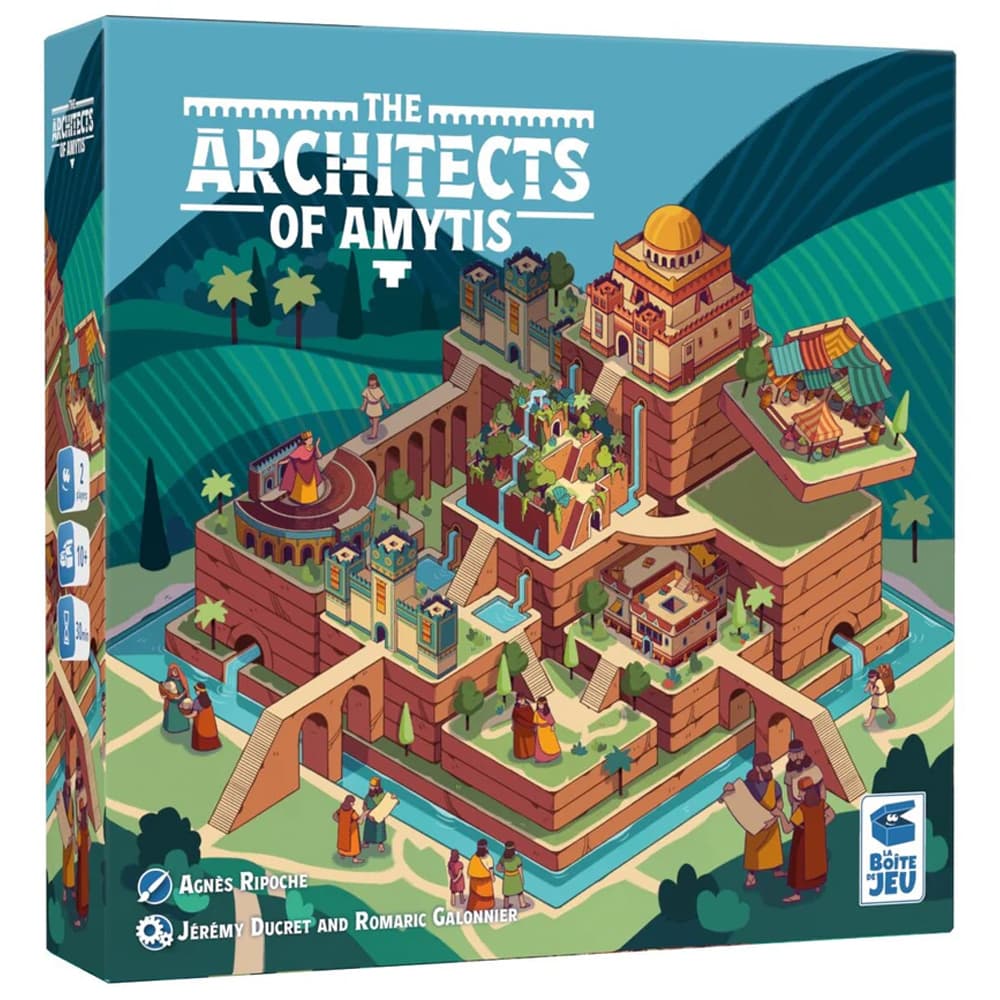
In The Architects of Amytis, two players are transported to ancient Babylon, where they assume the roles of rival architects competing for royal prestige. Commissioned by King Nebuchadnezzar II, your singular goal is to construct the most impressive and magnificent city district for his beloved wife, Queen Amytis. Victory is not achieved through a single grand gesture, but by meticulously accumulating points throughout the game. Players earn points by strategically placing building tiles, completing specific color patterns to satisfy royal 'Project Cards', and cleverly outmaneuvering their opponent to gain the 'King's Favor' for powerful endgame bonuses. The architect with the highest score when the final tile is laid will be celebrated as the greatest builder in all of Babylon.
The gameplay elegantly fuses several mechanics into a tight, interactive duel. The heart of the game is a shared 3x3 market grid, each space holding a stack of building tiles. On your turn, you select and draft one tile from any available stack. However, this choice comes with a crucial consequence: you must immediately place one of your architect pawns onto the now-vacant spot, blocking that stack from both players until your pawn is retrieved. The drafted tile is then placed onto your personal 3x3 city board, either on an empty space or atop an existing tile. Each placement triggers immediate scoring based on the building's type, with variable scoring cards ensuring no two games feel the same. This core loop is complicated by a brilliant spatial mini-game on the market board; if you successfully align three of your architect pawns in a row, column, or diagonal—much like tic-tac-toe—you earn a significant scoring bonus.
The Architects of Amytis is celebrated for its remarkable depth within a very accessible and fast-paced framework. While the rules can be taught in minutes, the strategic implications of each move are profound. The constant tension between improving your own city and blocking your opponent on the shared market creates a highly interactive and engaging experience. Players must constantly weigh their options: Do you take the perfect tile for your city, or do you draft a less optimal tile purely to block your rival or set up a tic-tac-toe victory on the market? This dual-layer puzzle, combined with high replayability from its modular scoring system, makes it a standout two-player game that offers a sharp, tactical challenge that respects players' time.
2 25m⚖️ 2.1

RANK #6,230
The Great Evening Banquet is a sophisticated board game that invites players into the high-stakes world of diplomatic event planning. Set within the prestigious walls of a brand-new state guest house, the game challenges you to act as a master of ceremonies tasked with organizing the ultimate social event. Your primary goal is to create harmonious seating arrangements for a diverse array of international dignitaries and VIPs. Each guest brings their own set of preferences and social requirements, turning the banquet hall into a complex grid of potential points and political pitfalls. The thematic essence of the game captures the tension and elegance of a formal gala, where the simple act of placing one person next to another can either foster international goodwill or result in a social faux pas.
The gameplay experience is built around a clever mix of token drafting and spatial puzzles. During each round, players draw guest tokens from a bag, introducing an element of controlled randomness that requires constant adaptation. These tokens are then selected through an open drafting mechanic, meaning you must stay vigilant about what your rivals are planning while securing the most beneficial guests for your own tables. The core challenge lies in the seating preferences of the VIPs; some may wish to be surrounded by their own entourage, while others provide bonuses based on the diversity of the table. The game progresses steadily until the grand chamber is filled, ensuring a tight, focused experience that rewards players who can think several moves ahead while managing the immediate tactical opportunities presented by the draft.
What truly distinguishes The Great Evening Banquet is its blend of approachable rules and deep, emergent strategy, a hallmark of the acclaimed publisher Saashi & Saashi. It offers a refined experience that appeals to fans of 'smart' family games, where the mechanics are easy to grasp but difficult to master. The inclusion of expert variants allows seasoned gamers to add layers of complexity, while the robust solo rules ensure that the seating puzzle is just as engaging when played alone. With its charming art style and the satisfying tactile feel of drawing tokens from a bag, the game provides a meditative yet competitive atmosphere. It perfectly captures the puzzle-like satisfaction of seeing a chaotic room transform into a perfectly ordered celebration, making it a standout title for anyone who enjoys abstract strategy with a strong thematic heartbeat.
1-4 45m⚖️ 2.2
BoxNo Cover Art
RANK #9,680
Azure
2026'Azure' (2026) is a captivating, Asian mythology-themed abstract strategy game designed strictly for two players. Centered around harnessing the mystical energy of the Lung Mei, or dragon paths, players compete to earn the favor of the Four Auspicious Beasts: the Azure Dragon, Vermilion Bird, White Tiger, and Black Tortoise. The ultimate goal is a tight, rhythmic race to reach twenty-five wisdom points before your opponent. By blending tactical stone placement with careful resource management, this beautifully illustrated game offers a highly interactive duel where every move holds significant weight.
The gameplay loop is structured around three straightforward yet deeply strategic steps on each turn. First, players manage a hand of colorful 'qi' energy cards to place a stone on an empty board space. The domain's color dictates the required qi, while printed boon symbols determine the exact card cost. Second, after placing a stone, players gather the underlying boons, rewarding them with essential new qi cards or immediate wisdom points. Finally, players resolve the Auspicious Beasts step. By strategically positioning stones to 'guard' specific mountain spaces, players vie for area majority over the four legendary creatures. Capturing a beast's favor grants a sudden influx of points and the physical beast figure, but this control is fleeting—if an opponent shifts the balance of power, they steal both the figure and the associated points, creating a dynamic tug-of-war.
Enthusiasts are drawn to 'Azure' for its elegant ruleset that masks profound tactical depth. Created by a renowned design duo famous for their two-player masterpieces, the game forces players to make agonizing decisions from a limited hand of cards while maintaining spatial dominance. The inclusion of a modular two-by-two grid using double-sided boards ensures immense replayability, offering over ten thousand possible map configurations. Furthermore, the perfect-information nature of the board—combined with striking visuals by a celebrated board game artist—rewards careful card counting and clever pivoting. For veterans seeking an extra layer of asymmetry, the 'Gifted' module provides variable, once-per-game abilities, cementing 'Azure' as a brilliantly tense and highly replayable modern abstract duel.
2 20m⚖️ 2.0

RANK #13,724
"Tembo: Survival on the Savanna" invites players to embark on a cooperative journey of immense challenge and strategic depth. In this game, you don't compete against each other but work together as a unified team, guiding a majestic herd of elephants across the perilous African savanna. The ultimate goal is to navigate this vulnerable group through a series of key landmarks, ensuring they find adequate food and water, before reaching a final, safe destination. Success is a collective triumph, but failure is an ever-present threat. The herd's journey can be cut short if they are caught by the relentless lions that stalk the plains, if they run out of time as indicated by the dwindling draw deck, or if they succumb to starvation. This shared objective fosters a rich environment of communication and collaborative problem-solving, making every decision a critical one for the entire group.
The gameplay is driven by a clever and restrictive card-playing system that forms the core of its puzzle. On your turn, you will draw a card and face a simple but profound choice: use the card to expand the savanna, laying down a new piece of terrain for the herd to cross, or use it to add more elephants to your path, extending the line of your migrating herd. This seemingly straightforward decision is complicated by a significant constraint: cards often have a fixed orientation determined by each player's seating position around the table. You cannot simply rotate a piece to fit the perfect spot. This rule transforms the game from a simple tile-laying exercise into a complex spatial puzzle that demands constant discussion, foresight, and adaptive planning among all players to overcome the environmental challenges presented on the board.
The unique appeal of "Tembo" lies in this compelling fusion of accessible, family-friendly rules with a genuinely challenging cooperative puzzle. The restriction on card orientation is a masterstroke of design, forcing players to think from different perspectives and communicate their intentions clearly to forge a viable path forward. This core mechanic ensures that no two games feel exactly alike. Further enhancing its longevity, the game includes options for scaling difficulty to match the players' experience level, a thoughtfully designed solo mode for individual play, and an engaging campaign mode that weaves a longer narrative across multiple sessions. Combined with the evocative and beautiful artwork from celebrated artist Vincent Dutrait, "Tembo" promises a deeply thematic and highly replayable experience for gamers seeking a strategic and heartfelt cooperative adventure.
1-4 45m⚖️ 2.3
BoxNo Cover Art
RANK #14,273
Set in the picturesque Burgundy region of fifteenth-century France, this acclaimed Eurogame casts players in the roles of ambitious aristocrats seeking to expand their influential princedoms. Regarded as an enduring classic of the tabletop hobby, the title challenges participants to build immense wealth and prominence over the course of five distinct phases. Although often mistakenly referred to under alternate monikers, the experience is synonymous with master designer Stefan Feld's brilliant vision, seamlessly blending strategic planning with rewarding tactical execution. A recent deluxe edition, fulfilled in 2025 through a notable collaboration between Awaken Realms and Ravensburger, has revitalized this masterpiece, ensuring that both veteran tabletop enthusiasts and newcomers can enjoy its rich, deeply engaging gameplay with upgraded components.
At its core, the gameplay revolves around a remarkably elegant dice-driven system layered with intricate tile placement and engine building mechanics. On each turn, participants roll two dice, using the specific numerical results to dictate their available actions. These choices include drafting hexagonal tiles from a central market, placing those drafted tiles onto their personal duchy board, selling accumulated goods, or acquiring vital worker tokens. The tiles themselves represent various developments for the expanding estate—such as imposing castles, lucrative silver mines, vital trading ships, verdant pastures, and diverse urban buildings. Every tile must be strategically placed onto a matching colored space adjacent to a previously established hex, demanding careful spatial planning. As the estate grows, participants trigger powerful chain reactions and unlock crucial abilities; ships advance your position on the turn order track, mines yield consistent income, and unique buildings grant immediate bonus actions or highly sought-after victory points.
The enduring appeal of this masterpiece lies heavily in its phenomenally balanced 'point salad' scoring structure, where virtually every strategic decision yields a path to victory. Players are consistently rewarded for completing colored regions on their boards, collecting comprehensive sets of livestock, successfully shipping mercantile goods, and leveraging powerful knowledge abilities. Furthermore, the inherent randomness of the dice is beautifully mitigated by the implementation of worker tokens, which allow players to expertly adjust their roll results by exactly one pip. This flexibility ensures that the experience remains a compelling, brain-burning puzzle rather than a mere game of chance. Celebrated for its remarkable scalability, it is widely considered exceptional at the two-player count while remaining incredibly engaging for up to four participants. The combination of satisfying engine building, dynamic set collection, and accessible yet profound medium-weight complexity cements its status as a legendary achievement in modern board gaming.
1-4 120m⚖️ 3.0

RANK #15,813
Keystone: North America – Second Edition invites players to step into the professional boots of a dedicated wildlife biologist, tasking them with the restoration and preservation of vibrant, interconnected ecosystems across the North American continent. The primary objective is to strategically arrange diverse species cards within a personal player grid to simulate a flourishing and stable natural habitat. Players must carefully balance the specific requirements of various flora and fauna, ensuring that their biological selections provide the necessary synergies to create a resilient environment. Whether you are competing head-to-head against a rival researcher or tackling the unique challenges of the wilderness in a solo capacity, the ultimate goal remains to generate the highest conservation score by fostering high levels of biodiversity and protecting essential keystone species.
The gameplay experience centers on a refined and engaging blend of open drafting and tile-placement mechanics. During each turn, players must select species cards from a common central market, weighing the specific habitat requirements and biological classifications of the animals they wish to introduce to their board. These cards are then placed onto a square grid, where their spatial relationship to neighboring cards becomes critical for scoring. Points are predominantly awarded based on color-coded habitat chains and numerical sequences, rewarding players who can visualize complex ecological patterns several turns in advance. The inclusion of special 'Keystone' animals provides powerful scoring bonuses but requires sophisticated planning to integrate effectively, making every placement a meaningful puzzle of tactical ecological balance.
What truly distinguishes this second edition is its impressive versatility and the depth of its thematic immersion. The game features a robust solo and cooperative narrative campaign through the 'Field Journal,' a fully illustrated adventure book that leads players through twenty unique scenarios across diverse North American climates. This edition has been specifically streamlined to provide a premium experience for one to two players while maintaining the 'brain-burning' strategic depth that enthusiasts of the original version celebrated. Featuring stunning, scientifically-inspired artwork from a talented team of illustrators, the game serves as both a challenging tactical exercise and a poignant tribute to the importance of conservation biology. Its elegant combination of beginner-friendly rules and rewarding strategic complexity makes it a definitive title for nature lovers and board game veterans alike.
1-2 45m⚖️ 2.0
BoxNo Cover Art
Mosaic
2018Mosaic is a strategic board game designed for 2-4 players, where each player takes on the role of an artist tasked with creating a stunning mosaic artwork within a set timeframe. The game's objective is to be the first player to complete their mosaic by collecting and placing tiles in a way that showcases their artistic vision. Players must carefully plan and manage their tile collection, as well as navigate the challenges of working under time pressure and competing against other artists.
Gameplay involves a combination of strategic planning, tactical execution, and a dash of luck. Each player starts with a set of basic tiles and a limited number of special power tiles that can be used to gain an advantage. As players collect more tiles, they must carefully consider which ones to use and where to place them in order to create the most visually appealing mosaic.
One of the unique features of Mosaic is its modular board, which consists of interlocking tile pieces that are arranged differently for each game. This ensures that no two games are ever the same, providing a high level of replayability and keeping players on their toes.
Mosaic has gained a loyal following among gamers due to its engaging gameplay, beautiful artwork, and social interaction. Players must communicate with each other, negotiate tile trades, and even sabotage their opponents' efforts in order to emerge victorious.
m⚖️ 3.0

Earth Express
2027Earth Express offers a vibrant, fast-paced journey into the world of nature, distilling the critically acclaimed engine-building experience of its predecessor, *Earth*, into a highly condensed and accessible format. In this standalone game, players compete to cultivate the most synergistic and valuable ecosystem. The goal is to strategically draft and place cards representing diverse flora, fauna, and terrains into a personal 3x3 grid. Victory is achieved by accumulating points from the intrinsic value of these cards, the resources they generate, and by successfully completing a mix of randomly drawn public objectives and secret private ecosystem goals. Whether you're creating a perfect habitat for a Bald Eagle or arranging columns of matching colors, every choice contributes to your final score in this beautifully illustrated race to build the best patch of wilderness.
The gameplay is elegantly structured over five distinct rounds, driven by a simultaneous card-drafting mechanic that eliminates downtime and keeps the pace brisk. Each player begins the first four rounds by selecting two cards from their hand to play, then passing the remainder to a neighbor. The final round concludes with a single card draft, completing each player's nine-card tableau. A signature mechanical twist is the concept of 'spatial locking'; once a card is placed into the 3x3 grid, its position is permanent, demanding careful forethought. After placement, engines activate in a cascading sequence from top-left to bottom-right, generating key resources like Soil, Seeds, and Growth. The game also introduces a clever component solution with slotted grid markers for tracking 'Sprouts', ensuring that the stunning card artwork remains unobscured throughout play.
What makes Earth Express so appealing is its remarkable ability to provide a deeply satisfying strategic puzzle in a session that can last as little as 20 minutes. The simultaneous action selection allows the game to scale effortlessly from a solo challenge up to eight players without increasing the playtime, making it an incredibly versatile choice for any game night. By constraining the play area to a fixed grid and locking card positions, the design cleverly mitigates the analysis paralysis often found in larger tableau-builders. This creates a snappy, engaging, and approachable experience that's perfect as a 'filler' game for serious hobbyists or a main event for more casual players. It successfully captures the spirit of its bigger sibling while carving out its own identity as a quick, replayable, and rewarding engine-building game.
1-8 30m⚖️ 2.1
BoxNo Cover Art
Explore the rich industrial landscape of Catalonia in this highly acclaimed fan expansion for the iconic Brass board game. Players are thrust into the pivotal era of the Industrial Revolution, tasked with establishing a dominant economic empire across Spain's vibrant northeastern region. The ultimate goal is to amass the most victory points by strategically developing industries, constructing crucial transportation links, and efficiently managing resources to outmaneuver rival industrialists. This expansion offers a fresh geographical challenge and intricate strategic decisions for dedicated fans of the Brass series.
Catalonia retains the core, beloved mechanics of Brass, inviting players to make critical choices between building new factories, developing advanced technologies, and expanding their network of canals and railways. Each round demands careful planning as players balance short-term income generation with long-term strategic positioning. The innovative 'flipping' mechanic for industries—where built industries are only valuable once consumed by the market—remains central, creating a dynamic economic puzzle that forces players to adapt to an ever-changing board state. Managing loans, income, and rival actions is paramount to success.
What truly captivates players about the Catalonia expansion, much like its esteemed predecessor, is its profound strategic depth and the satisfying challenge of optimizing an industrial engine. It offers experienced Brass enthusiasts a captivating new map and regional specificities that demand a mastery of economic principles and network building. This fan creation revitalizes the game with a new historical flavor, ensuring high replayability and endless opportunities for strategic innovation within one of the greatest economic Eurogames ever designed. It's a must-play for those seeking a sophisticated industrial development experience.
m⚖️ N/A

Garden Club
2026Step into the tranquil yet surprisingly competitive world of 'Garden Club', a beautifully designed two-player board game where participants take on the roles of enthusiastic cultivators vying for the esteemed title of Club President. Over the course of three distinct seasons—Spring, Summer, and Fall—players must carefully curate a shared community garden while simultaneously nurturing their own personal harvests. By expertly planting a vibrant array of fruits, vegetables, and flowers, contenders strive to complete secret club objectives and cultivate the most impressive arrangements. With its welcoming nature theme and approachable rule set, it offers a cozy aesthetic masking a deeply engaging tactical puzzle that unfolds over an efficient 30 to 45 minutes of playtime.
The core gameplay loop centers around a clever combination of open drafting, tile placement, and engine building mechanics. Each turn, a player selects two double-sided tiles from four available stacks. One side features various types of produce and blooming flowers, while the reverse side displays harvest multipliers. Decisions carry significant weight, as one drafted tile must be added to the central shared garden, while the other is placed on the player's individual harvest board. During the initial Spring round, players establish a foundational four-by-four grid in the community area. However, as Summer and Fall arrive, the available actions decrease, and players must begin stacking tiles directly on top of previously planted flora. This three-dimensional layering dynamic forces constant tactical shifts, as players cover up opponents' carefully arranged patterns to score points through secret project cards and matching sets.
What truly sets 'Garden Club' apart is the brilliant tension between the shared play space and personal progression. End-of-season scoring introduces a fascinating area majority mechanic, where points for vegetable sets in the communal garden are only awarded to the player who controls the most of that specific produce type on their private harvest board. This delicate balancing act—deciding whether to improve your own multipliers or sabotage your rival's carefully laid garden plots—makes every single decision impactful. Aided by specialized tool cards like the Spade or Garden Fork, players can cleverly manipulate the grid to their advantage. Praised as highly accessible yet sneakily strategic, this lightweight duel perfectly caters to casual gaming couples and seasoned enthusiasts alike who appreciate a cutthroat spatial puzzle wrapped in a charming, botanical package.
2 45m⚖️ 2.3
Showing 37 to 46 of 46 games