Ancient Games
Browse all Ancient board games in the Meeple Pulse database.
Styles
Themes
AbstractAdventureAncientAnimalsArtBusinessCard GameCo-operativeComic BookCooperativeCrimeEconomicEnvironmentalismExplorationFantasyHistoricalHorrorHumorIntrigueLiteraryMagicMarvelMedievalModernMuseumMysteryMythologyNatureNauticalPoliticalPress Your LuckSatireSci-FiSocial CommentarySocial InteractionSpaceSuperheroesThematicTravelWarWesternWord-Guessing
Mechanics
3D PlacementActingAction / DexterityAction DraftingAction Point AllowanceAction Point Allowance SystemAction Point SystemAction PointsAction ProgrammingAction QueueAction RetrievalAction SelectionAction/EventAlliancesAlternate ActivationApp-AssistedApp-DrivenArea ControlArea InfluenceArea MajorityArea Majority / InfluenceArea MovementArgumentationAsymmetricAsymmetric FactionsAsymmetric GameAsymmetric PowersAsymmetrical PowersAuction & BiddingAuction/BiddingAuctioningBag BuildingBettingBetting and BluffingBetting and WageringBetting and WagersBiddingBingoBlind BiddingBluffingCampaign / Battle Card DrivenCampaign / LegacyCampaign / Legacy GameCampaign / Mission-basedCampaign / ScenariosCampaign GameCampaign PlayCard DraftingCard DrawingCard DrivenCard Driven ActionCard Driven CombatCard Driven Dice AllocationCard Driven MovementCard ManagementCard PlayCard Play / Hand ManagementCard Play Conflict ResolutionCard SheddingCard-Driven MovementCharacter CreationCharacter ProgressionChit-Pull SystemCo-op PlayCo-operative GameCo-operative PlayCode-breakingCombat ResolutionCombo ChainCommand CardsCommodity SpeculationCommunication LimitsContract FulfillmentContractsCooperative GameCooperative GameplayCooperative PlayCooperative Trick-takingDebateDeck BuildingDeck ConstructionDeck, Bag, and Pool BuildingDeck-BuildingDeductionDexterityDice DraftingDice PlacementDice RollingDiplomatic InfluenceDraftingDynamic Battle SystemEnclosureEnd Game BonusesEngine BuildingEngine-BuildingEscape RoomEvent DrivenExplorationFarmingFlip and WriteFollowFollow ActionGrid CoverageGrid MovementHand ManagementHex-and-CounterHexagon GridHidden MovementHidden RolesI Cut You ChooseIncomeInfluence / Area MajorityLadder ClimbingLegacyLegacy ElementsLegacy GameLegacy SystemLimited CommunicationLine DrawingLine of SightMancalaMap MovementMarketMarket DraftingMarket ManipulationMarket MechanicMarket SpeculationMatchingMeasurement MovementMemoryMission ObjectivesModular BoardModular Board ConstructionMovement TemplatesMulti-Use CardsMulti-use CardsMultiple ScenariosMust FollowNarrative ChoiceNarrative Choice / ParagraphNegotiationNegotiation MechanicsNetwork & Route BuildingNetwork BuildingNetwork and Route BuildingOne vs ManyOne vs. ManyOpen DraftingPaper-and-PencilPartnershipsPattern BuildingPattern RecognitionPick-up and DeliverPlayer EliminationPlayer InteractionPlayer JudgePoint SaladPoint to Point MovementPolyominoesPush Your LuckPush-Your-LuckPuzzlePuzzle-LikePuzzle-SolvingRaceReal-TimeRecipe FulfillmentResource ManagementRole PlayingRole SelectionRoll / Spin and MoveRondelRoute BuildingRoute-BuildingRoute/Network BuildingSanity SystemScenario / Campaign PlayScenario / Mission / Campaign GameScenario / Mission FunctionSecret Unit DeploymentSemi-Cooperative GameSet CollectionSheddingSimulationSimultaneous ActionSimultaneous Action SelectionSimultaneous Hidden AllocationSocial DeductionSocial InteractionSolo / Solitaire GameSpace ExplorationStat Check / Skill CheckStock HoldingStorytellingStrategic PlanningTableau BuildingTactical Decision-MakingTake ThatTargeted CluesTeam PlayTeam-Based GameTeam-Based GuessingTeamworkTech TreesTech Trees / Tech TracksTechnology & Armament TracksTechnology TreeTension & Aggression TracksTile DraftingTile LayingTile PlacementTime TrackTime TravelTower DefenseTrack MovementTradingTrick-takingTug of WarTurn Order: PassTurn Order: Stat-BasedUnit PlacementVariable Phase OrderVariable Player PowersVariable Set-upVariable SetupVictory Point TracksVotingWord AssociationWord GameWord GuessingWord-GuessingWord-guessingWordplayWorker Placement

RANK #29
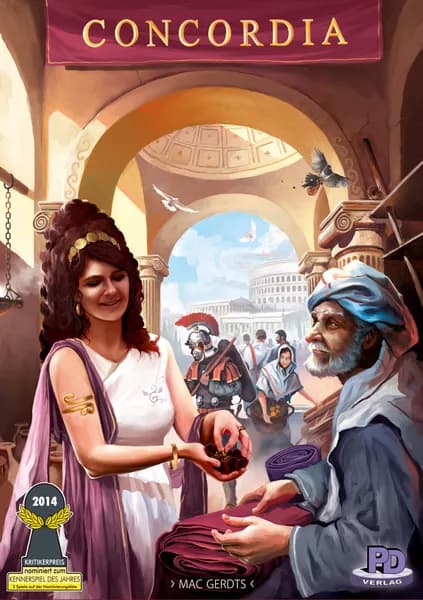
Concordia
2013Concordia is an elegant strategy board game where 2-5 players become powerful Roman merchants, striving to expand their trading empire across the Mediterranean. The goal is not just wealth, but prestige, earned through wise expansion, strategic trading, and efficient use of specialist cards. Players build outposts, produce goods, and colonize new provinces to accumulate victory points based on their unique set of personality cards, making every game a fresh challenge.
At its heart, Concordia features a brilliant card-driven action system combined with robust hand and resource management. Players use a limited hand of 'personality cards' to perform actions like building, moving, trading, or generating resources. Crucially, a 'Tribune' card allows players to retrieve their discarded cards, adding a fascinating rhythm to the game's flow. Area movement is key as players expand their presence across a modular map, establishing trade routes and monopolizing regions.
Players love Concordia for its incredibly streamlined rules that belie a deep strategic experience. It offers immense replayability through various map boards and the evolving set of available personality cards. With virtually no luck elements, it rewards efficient planning, forward-thinking, and adaptability, making it a favorite among Eurogame enthusiasts seeking a pure, engaging economic strategy game that stands the test of time.
2-5 100m⚖️ 2.9
BoxNo Cover Art
RANK #72
Tzolk'in: The Mayan Calendar is a deeply strategic Eurogame where players assume the roles of Mayan tribal leaders vying for the favor of the gods. The ultimate goal is to accumulate the most victory points by the time the massive central calendar gear completes one full revolution. Victory is achieved through a combination of constructing monumental buildings, advancing on temple tracks, developing crucial technologies, and strategically placing valuable crystal skulls. The game is renowned for its visually stunning and mechanically innovative centerpiece: a series of interlocking gears that dictate the flow of the game, representing the cyclical nature of the Mayan calendar and demanding foresight from its players.
The gameplay is driven by a unique 'dynamic worker placement' mechanism. On their turn, a player makes a simple but crucial choice: either place one or more workers on the starting spots of the five action gears, paying in corn, or retrieve one or more workers already on the board. The twist is that actions are only performed when a worker is *retrieved*. Between turns, the central Tzolk'in gear rotates, advancing all workers to more powerful action spaces. This creates a compelling tension: leaving workers on the gears longer yields better rewards—more resources, more powerful building actions, or greater favor with the gods—but it also means delaying your access to those rewards and potentially running out of workers to place. Players must carefully manage their resources like corn, wood, stone, and gold to fuel their placements and constructions, all while balancing the timing of retrieving their workers for maximum effect.
What makes Tzolk'in a beloved classic is this constant temporal puzzle. It's not just about *what* action to take, but *when*. The rotating gears force a long-term strategic perspective, as players must plan several turns ahead to align their worker retrievals with their goals and available resources. Every turn of the great central gear changes the board state, making each decision impactful and every game a different strategic challenge. This system eliminates randomness in favor of pure strategic planning, rewarding players who can master the rhythm of the calendar. The intricate interplay between resource management, technological advancement, and the ever-ticking clock of the gears provides a rich, challenging, and immensely satisfying experience that has cemented its place as a cornerstone of modern board gaming.
2-4 90m⚖️ 4.0
RANK #169
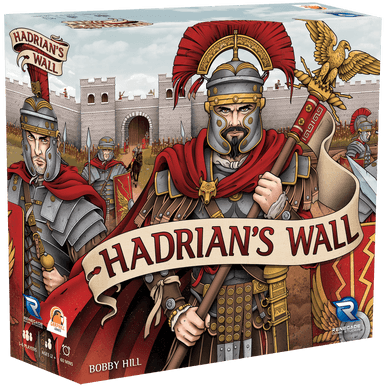
Hadrian's Wall
2021In Hadrian's Wall, you assume the demanding role of a Roman General charged with a monumental task: the construction and defense of a critical segment of the wall that separates Roman Britannia from the unconquered north. This is a deeply strategic 'flip-and-write' game where your ultimate objective is to prove your superior command by amassing the most victory points. Your final score is a reflection of your overall success, tallied across four distinct paths to glory: Renown for your grand constructions, Piety for honoring the gods, Valour for your military prowess, and Discipline earned by managing your domain efficiently. The player who best balances civic development with unwavering defense against the relentless Picts will be celebrated as the most distinguished general in the Empire.
The game unfolds over six years, each a tense round of planning, building, and fighting. Each year begins with a shared 'Fate' card that provides a foundation of resources and workers for all players. You then supplement these supplies by drawing from your personal deck, strategically choosing one card for its immediate resources and another for its potential end-game scoring objectives. The heart of each round is the simultaneous action phase, where you allocate your workers—Soldiers, Builders, Citizens, and Slaves—and spend resources to fill in spaces on your two intricate player sheets. One sheet tracks the progress of your wall, forts, and defenses, while the other maps out the growth of your civilian settlements. Marking off boxes often triggers powerful combos, unlocking additional resources or actions in a satisfying cascade, allowing for clever and explosive turns. The year culminates in a climactic attack by the Picts, where your carefully built defenses are put to the test.
Hadrian's Wall stands out for its remarkable depth and complexity, offering a 'crunchy', thinky experience that elevates the flip-and-write genre. While players act simultaneously, the gameplay is a focused 'multi-player solitaire' puzzle, where the primary challenge is optimizing your own engine of progress. The true magic lies in discovering the intricate synergies on your player sheets and engineering powerful chain reactions where a single action can fuel a dozen more. This engine-building element, combined with the constant pressure to erect sufficient defenses before the annual Pict assault, creates a compelling and highly rewarding strategic challenge. It’s a game that appeals to players who relish complex decision-making, meticulous planning, and the immense satisfaction of watching their personal section of the Roman frontier flourish under their command.
1-6 60m⚖️ 3.0
RANK #187
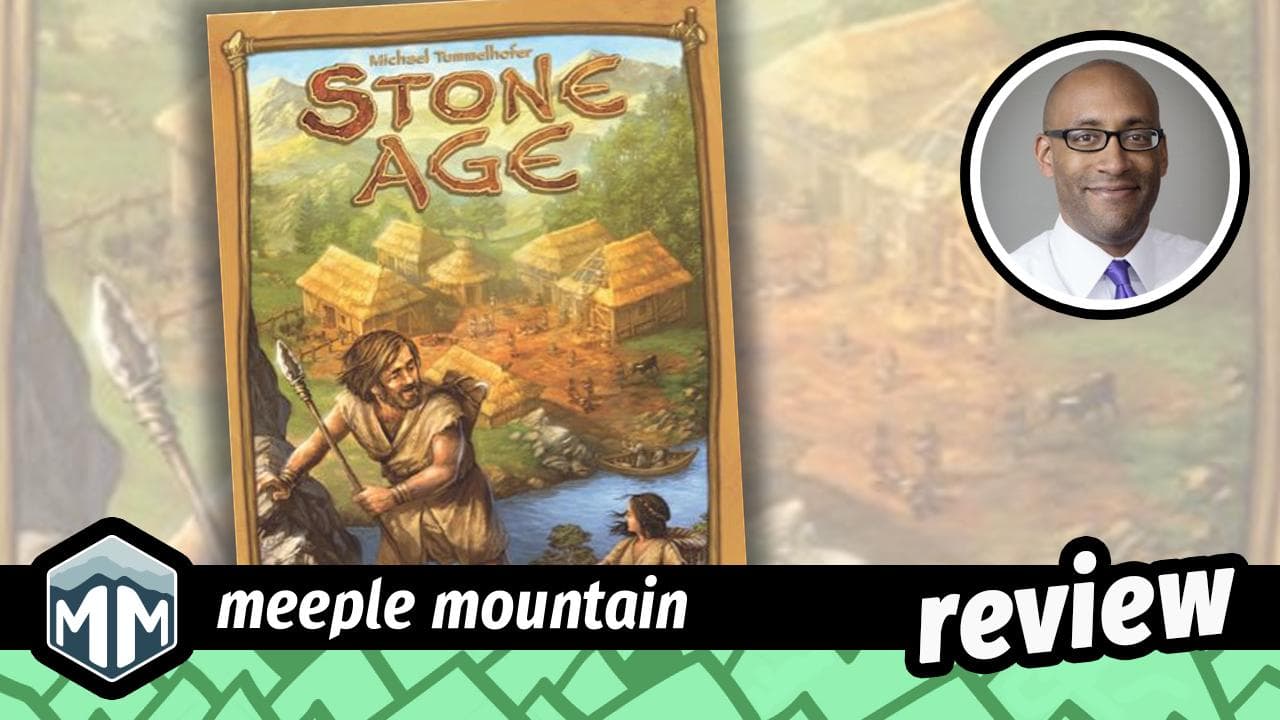
Stone Age
2008Stone Age invites players to the dawn of civilization, casting them as leaders of a burgeoning tribe. This quintessential "gateway" game, first released in 2008, serves as a perfect introduction to the worker placement genre. Your goal is to guide your people to prosperity by strategically gathering resources, developing new technologies, and expanding your village. The ultimate path to victory lies in accumulating the most victory points, which are earned primarily by constructing useful buildings and acquiring valuable civilization cards. These cards reward players for achieving specific long-term goals, such as building a diverse village or growing a large tribe. The player who best balances the immediate needs of their people with the foresight required for a thriving society will be crowned the winner.
The core gameplay is structured around a simple, repeating cycle: placing workers, taking actions, and feeding your tribe. In turn order, players assign their tribe members to various action spaces on the board. These locations allow for hunting, gathering resources (wood, clay, stone, gold), expanding your family, improving agriculture, or crafting helpful tools. Competition for limited spots creates engaging player interaction. Once all workers are placed, their actions are resolved. Resource gathering introduces a clever dice-rolling mechanism: the number of workers sent determines the number of dice you roll. The total is then divided by a specific value for each resource type to determine your yield, creating a fun risk-reward system. Finally, each round concludes with the critical feeding phase, where every tribe member requires food, pushing players to maintain a sustainable food supply or risk penalties.
The enduring appeal of Stone Age lies in its masterful blend of accessibility and satisfying strategic depth. Its rules are easy to grasp, making it an excellent choice for families and those new to the hobby. Yet, the game offers a wealth of meaningful choices that keep experienced players engaged. Do you prioritize increasing your population for more actions, or focus on agriculture to ease the constant demand for food? Do you pursue immediate points from buildings or invest in civilization cards for a big payoff at the end? The element of luck from the dice rolls adds just enough unpredictability to keep the game exciting and prevent it from becoming a purely deterministic puzzle. This elegant design, combined with Michael Menzel's charming and thematic artwork, creates a warm, inviting, and highly replayable experience that remains a staple in the board gaming world.
2-4 75m⚖️ 2.4
RANK #269
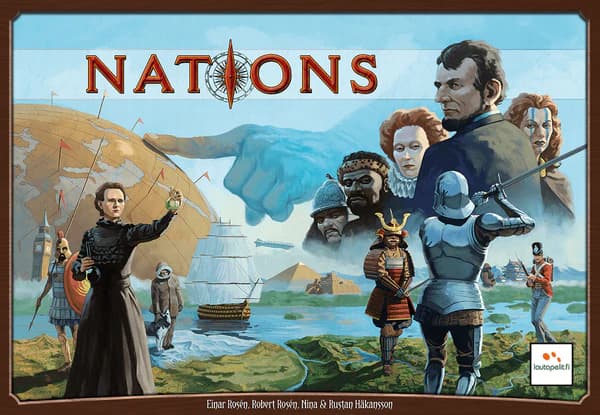
Nations
2013In Nations, you take the helm of a burgeoning civilization, guiding it from the annals of antiquity to the cusp of the First World War. Your ultimate objective is not conquest, but the creation of a lasting legacy, measured in victory points earned through cultural achievements, magnificent wonders, valuable colonies, and historical renown. Players must skillfully navigate the challenges of history to build the most prestigious and prosperous nation. The game is an epic race to accumulate the most 'books', which symbolize your civilization's accumulated knowledge and cultural impact, proving your dominance through wisdom and development rather than brute force.
The game unfolds over eight rounds, divided into four historical ages: Antiquity, Medieval, Renaissance, and Industrial. Each round is a meticulously structured sequence of phases. Players begin by preparing for the challenges ahead, revealing new progress cards and a pivotal event card. The heart of the game is the action phase, where players take turns performing one action at a time, with the player possessing the strongest military going first. Actions are varied and strategic: you might purchase a new technology or building from a shared card row, deploy your workers to activate structures for resources, or assign an architect to the monumental task of constructing a world wonder. Competition is indirect but fierce, as players vie for military superiority to set the turn order and manage the effects of historical events, all while managing resources and keeping their populace stable.
Nations is celebrated for offering a profound and satisfying civilization-building experience within a streamlined and manageable playtime. It captures the grand sweep of history without the complex combat systems or map-based conflicts common to the genre, instead focusing on a tense, indirect struggle for supremacy. Its unique appeal stems from the delicate balancing act required to succeed. You must constantly weigh the immediate needs of your people—food and stability—against long-term investments in military, culture, and economic infrastructure. The variable card market and unpredictable events ensure that each game presents a new strategic puzzle, making Nations a highly replayable and engaging journey through time for strategy enthusiasts.
1-5 120m⚖️ 3.4
RANK #294
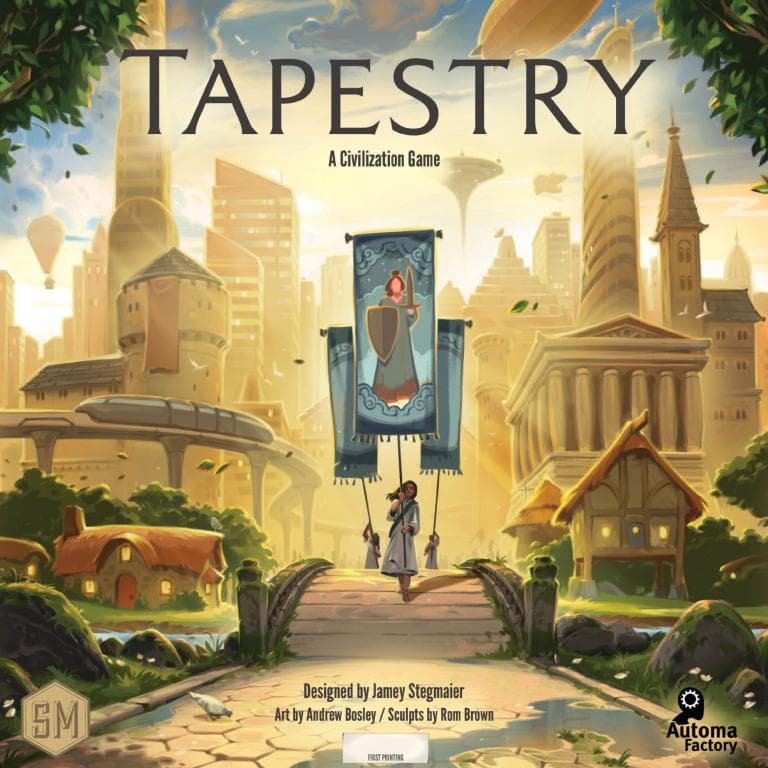
Tapestry
2019Tapestry is a civilization-building board game that breaks away from traditional historical simulations by offering a colorful, anachronistic approach to human development. Designed by Jamey Stegmaier, the game challenges players to guide a unique culture from the earliest days of discovery into the technological wonders of the near future. The primary goal is to accumulate the most victory points by advancing on four core tracks: Science, Technology, Exploration, and Military. Unlike typical '4X' games that focus heavily on combat, Tapestry emphasizes a strategic optimization puzzle where players craft their own narrative through cards and landmarks within their growing capital city.
The heart of the experience lies in a streamlined decision-making process. On every turn, a player chooses between an Advancement turn or an Income turn. Advancement involves spending resources to climb one of the four tracks, each providing immediate rewards, permanent upgrades, and powerful landmark miniatures. When resources run dry, players take an Income turn to transition into a new era. This phase allows them to collect income based on their current progress, play a Tapestry card that defines their civilization's special abilities for that era, and upgrade technology. This asymmetric structure is further enhanced by sixteen distinct civilization mats, each granting game-changing powers that require players to pivot their strategies constantly.
What truly sets Tapestry apart is its high production value and the 'simple rules, deep strategy' philosophy. The game features 18 prepainted landmark miniatures that players place on their Capital City grids to complete 3x3 districts, adding a tactile tile-laying element. Because players take exactly five income turns throughout the session, the pacing varies significantly between participants. One player might conclude their journey early while others are still in their fourth era, creating a unique tension in resource efficiency. It is a medium-weight engine-building experience that rewards long-term planning while remaining accessible to many due to its concise rulebook, offering high replayability through variable setups and asymmetric components.
1-5 105m⚖️ 2.9
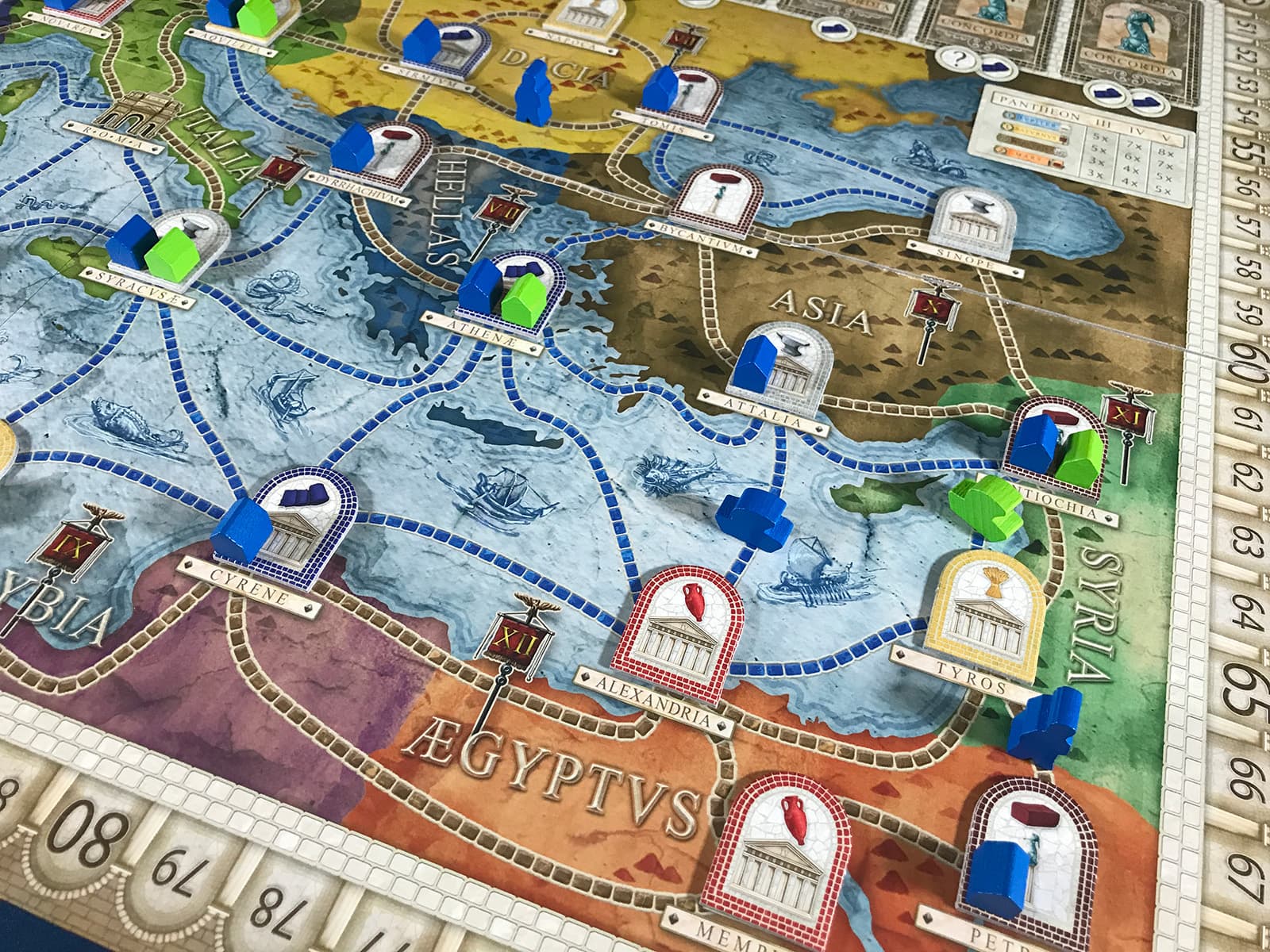
Concordia: Solitaria transforms the acclaimed eurogame Concordia into a compelling experience for 1 or 2 players, maintaining its elegant blend of strategy and efficiency within the Roman Empire. Players strive to establish a vast trading network, colonize new provinces, and ultimately become the most influential Roman merchant. The core goal remains earning the most victory points by carefully planning your actions and specializing your settlements, all while adapting to the unique challenges of a solo opponent or a tight two-player duel.
At its heart, Solitaria uses Concordia's signature card-driven action system, where each turn you play one of your limited action cards to perform tasks like moving colonists, producing goods, trading, or buying new action cards. For solo play, the 'Contrarius' automa provides a dynamic and unpredictable opponent, mimicking a human player's actions with minimal upkeep, forcing you to optimize your strategy under pressure. In a two-player game, Solitaria offers a more focused and competitive interaction, where every move on the shared map matters even more.
Fans adore Concordia: Solitaria for its brilliant adaptation of a beloved classic, delivering a robust solo mode that truly feels like playing against another human. It captures the essence of the original's strategic depth and replayability without the need for a full group. Its streamlined rules for the automa make for engaging decisions without overwhelming complexity, making it a perfect choice for those seeking a highly replayable and strategically rewarding game for solitary sessions or intimate duels.
1-2 45m⚖️ 2.8
BoxNo Cover Art
Concordia: Special Edition (2027) invites players to relive the glory of the Roman Empire, strategically expanding their influence across the Mediterranean. As powerful Roman families, your ultimate goal is to establish robust trade networks, build prosperous colonies, and master the art of economic prowess to accumulate the most victory points. This acclaimed Eurogame is celebrated for its elegant design, focusing on indirect player interaction and a satisfying blend of strategic depth with accessible rules, making it a cornerstone for serious board game enthusiasts and new strategists alike.
At its core, Concordia utilizes a brilliant action selection mechanism driven by a hand of persona cards. Each turn, players play one card to perform a specific action – such as colonizing new provinces, producing goods, trading resources, or acquiring new persona cards to expand their strategic options. The game's unique card-driven engine building allows for flexible play, where optimizing your hand and understanding the timing of your actions is paramount. Unlike many Eurogames, there's no dice rolling or random events; success hinges purely on your tactical decisions and foresight, rewarding careful planning over luck.
What truly sets Concordia apart is its remarkable replayability and 'low aggression, high interaction' dynamic. While players don't directly attack each other, competition for prime building locations, valuable resources, and crucial persona cards creates constant tension and strategic races. The scoring system, tied to various Roman gods, encourages diverse strategies and ensures that no single path to victory dominates, inviting players to explore different approaches in every game. This Special Edition promises an enhanced experience of a timeless classic, offering a premium presentation of a game renowned for its smooth gameplay, intellectual challenge, and enduring appeal.
2-5 120m⚖️ 3.2
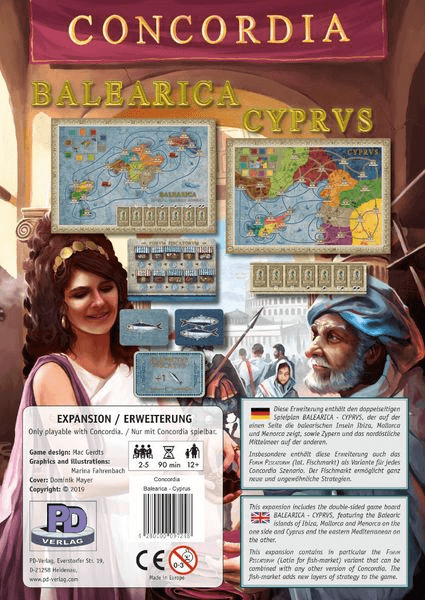
Expand your ancient Roman empire with "Concordia: Balearica / Cyprus," an essential expansion for the critically acclaimed strategy game Concordia. This pack introduces two new double-sided game boards, Balearica and Cyprus, offering fresh tactical landscapes and strategic challenges. The core goal remains the same: cleverly manage your hand of persona cards to expand your trading network, establish colonies, and accumulate wealth and influence across the Mediterranean, ultimately aiming to be the most successful Roman merchant.
Gameplay revolves around elegant hand management, where each persona card played triggers a specific action – from moving your colonists and building trading posts to producing goods and acquiring more powerful cards. The new maps, Balearica (for 2-4 players) and Cyprus (optimized for 2-3 players), introduce unique geographic features and resource distributions that demand tailored strategies. Players must adapt their plans, consider new adjacency bonuses, and navigate tighter competitive spaces, especially on the smaller Cyprus map, leading to intense player interaction and clever maneuvering.
"Concordia: Balearica / Cyprus" is beloved for enhancing an already brilliant design without adding unnecessary rules bloat. It provides exceptional replayability and offers new strategic puzzles, particularly for smaller player counts, which many expansions neglect. Fans appreciate how the new maps refresh the Concordia experience, allowing them to explore alternative opening moves and mid-game developments, solidifying Concordia's reputation as a deep, rewarding economic strategy game that stands the test of time.
2-4 90m⚖️ 2.8
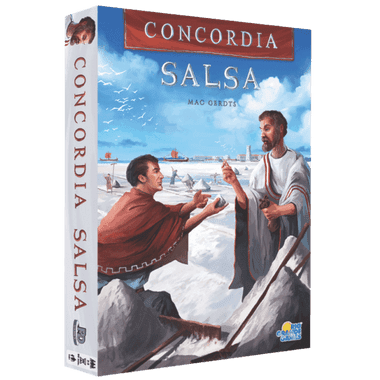
Concordia: Salsa
2015Concordia: Salsa (2015) is a highly anticipated expansion for the critically acclaimed strategy game Concordia, enriching the Roman Empire-era economic experience. This expansion introduces two new maps – Byzantium and Egypt – alongside two innovative modules: 'Salt' and the 'Forum'. Players continue their quest to establish the most prosperous trading empire by strategically expanding across the Mediterranean, managing their hand of personality cards, and collecting valuable resources. The ultimate goal remains to score the most victory points, primarily determined by the diverse types of colonists, goods, and provinces they've established and collected throughout the game.
Gameplay in Concordia: Salsa expands upon the elegant card-driven core of Concordia. Players use their hand of identical personality cards to perform various actions like moving colonists, producing goods, trading, or buying new cards. The 'Salt' module introduces a new, highly flexible resource that can substitute for any other good, adding a layer of strategic depth to resource management and trade. The 'Forum' module introduces a market of unique bonus tiles, granting players powerful one-time or ongoing abilities when claimed, further diversifying strategic choices and offering exciting new ways to specialize or adapt. These additions seamlessly integrate with the base game, providing more paths to victory and dynamic player interactions.
Fans adore Concordia: Salsa for its brilliant integration of new elements without sacrificing the base game's renowned elegance and strategic depth. The 'Salt' resource offers greater tactical flexibility, while the 'Forum' tiles introduce exciting variable player powers and a unique race component, enhancing replayability and creating fresh challenges in every play. It maintains Concordia's signature low-luck, high-strategy appeal, rewarding careful planning and efficient execution, making it a must-have for those seeking to deepen their mastery of this modern classic and explore new strategic horizons.
2-5 120m⚖️ 3.0
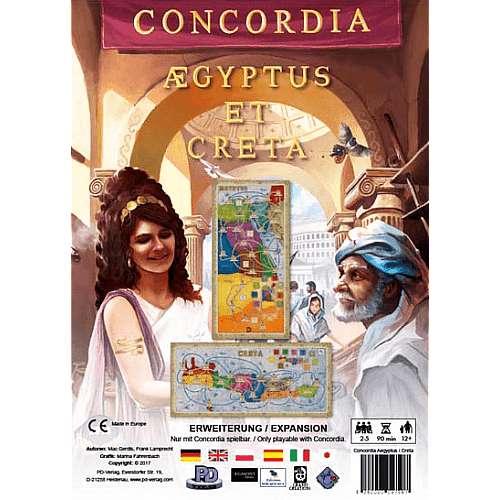
Concordia: Aegyptus / Creta is a highly anticipated expansion for the critically acclaimed strategy board game, Concordia, offering players exciting new maps and strategic challenges. In this elegant eurogame, aspiring Roman merchants vie to establish prosperous trade networks across the ancient Mediterranean. The ultimate goal is to accumulate the most victory points by efficiently colonizing provinces, producing valuable goods, and wisely managing your hand of personality cards to expand your influence and wealth. This expansion introduces two distinct maps: Aegyptus, designed for 2-4 players, and Creta, tailored for a more intimate 2-3 player experience, each presenting unique geographical layouts and strategic considerations.
Gameplay in Concordia is renowned for its streamlined yet deep card-driven action system. Players start with an identical hand of seven personality cards, each allowing a specific action like moving colonists, producing resources in cities, trading goods, or purchasing new, more powerful cards. The core loop involves playing a card, executing its action, and eventually using a 'Tribune' card to recall all previously played cards, including any new ones acquired. This deck management combined with clever area control, resource management, and economic engine building creates a constantly evolving strategic puzzle, where every decision about card play, colonist placement, and resource production has significant long-term implications for your burgeoning empire.
Concordia is beloved by strategy enthusiasts for its remarkable elegance, minimal luck, and profound strategic depth, making it a cornerstone of modern eurogame design. The Aegyptus / Creta expansion significantly enhances replayability by providing fresh geographical canvases and varying player count dynamics, forcing seasoned players to adapt their strategies and offering new tactical puzzles to solve. Its unique appeal lies in the absence of direct conflict, focusing instead on efficient economic growth and indirect competition, rewarding forward planning and clever card optimization. Discover new pathways to victory and solidify your legacy as the most influential merchant of the ancient world.
2-4 120m⚖️ 2.9
Showing 1 to 12 of 13 games